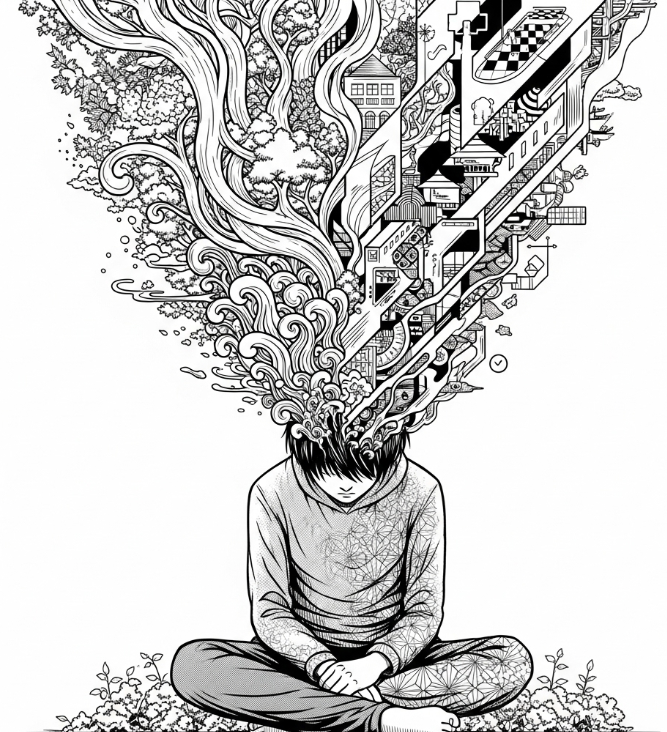
Dans la quête intérieure, que ce soit par une religion, une spiritualité ou la psychologie, un questionnement surgit quant à ce que nous sommes vraiment. C’est d’ailleurs une récurrence dans la culture pop de voir une espèce de mutation de l’être au travers d’épreuves qui donnent une sorte d’éveil d’un soi véritable.
Beaucoup sont dans cette quête, cherchant soit à remplir une mission de vie, soit à devenir ce qu’ils pensent réellement être. Et pourtant, s’il est stimulant de se dire que nous sommes peut-être plus ou autre chose que ce que nous sommes actuellement, il est fort probable que nous ne puissions jamais être purement soi.
Reprenons un concept freudien facile à comprendre : il y a les pulsions (le Ça) et les règles imposées (le Surmoi). On pourrait se dire que si nous voulions retourner à notre « nature profonde », il faudrait se défaire de la culture, ou du moins la minimiser si cette dernière étouffe notre nature.
Pourtant, plus on s’associe à ses pulsions, plus cela peut devenir infernal dans les cadres sociaux et dans sa propre vie. Vous voyez quotidiennement ce que cela donne dans les faits divers quand nous sommes guidés par nos pulsions. Le Surmoi, lui, peut et même doit empêcher un excès du Ça, pour éviter des comportements problématiques pour soi et pour les autres.
Être un soi sans limite est potentiellement un soi premier, ou plutôt primitif, qui ne peut vivre en communauté. C’est pour cette raison que nous ne sommes ni nature ni culture, mais un mélange des deux. Et que derrière cette quête d’un soi plus naturel et authentique, nous voudrions voir le nous sans les ajustements que les systèmes familiaux et sociaux ont formés.
Mais, même si cette culture est parfois de piètre qualité, elle apporte certains codes et signaux qui offrent la possibilité à un fragment ou à une large partie de soi d’exister, alors qu’il est fort probable que si nous n’étions que nature, cela ne serait pas le cas.
Prenez ce qui est juste et bon pour vous.
Be One
Pank
—
Reflections by Pank / Snapshot #417: Accepting that we can never truly be Ourself
In the inner quest, whether through religion, spirituality, or psychology, a question arises as to what we truly are. It is, moreover, a recurring theme in pop culture to see a kind of mutation of the being through trials that lead to an awakening of a true self.
Many are on this quest, seeking either to fulfill a life mission or to become what they truly believe they are. And yet, while it is stimulating to think that we might be more or something different from what we currently are, it is highly probable that we can never be purely ourselves.
Let’s revisit an easy-to-understand Freudian concept: there are impulses (the Id) and imposed rules (the Superego). One might think that if we wanted to return to our « deep nature, » we would have to shed culture, or at least minimize it if it stifles our nature.
However, the more one aligns with their impulses, the more infernal it can become within social frameworks and in one’s own life. You see daily what happens in the news when we are guided by our impulses. The Superego, for its part, can and even must prevent an excess of the Id, to avoid problematic behaviors for oneself and for others.
To be a self without limits is potentially a primary, or rather primitive, self that cannot live in a community. This is why we are neither nature nor culture, but a blend of both. And behind this quest for a more natural and authentic self, we would like to see ourselves without the adjustments that family and social systems have formed.
But, even if this culture is sometimes of poor quality, it brings certain codes and signals that offer the possibility for a fragment or a large part of oneself to exist, whereas it is highly probable that if we were only nature, this would not be the case.
Take what is right and good for you.
Be One
Pank




 Laboratoire Hypnose