
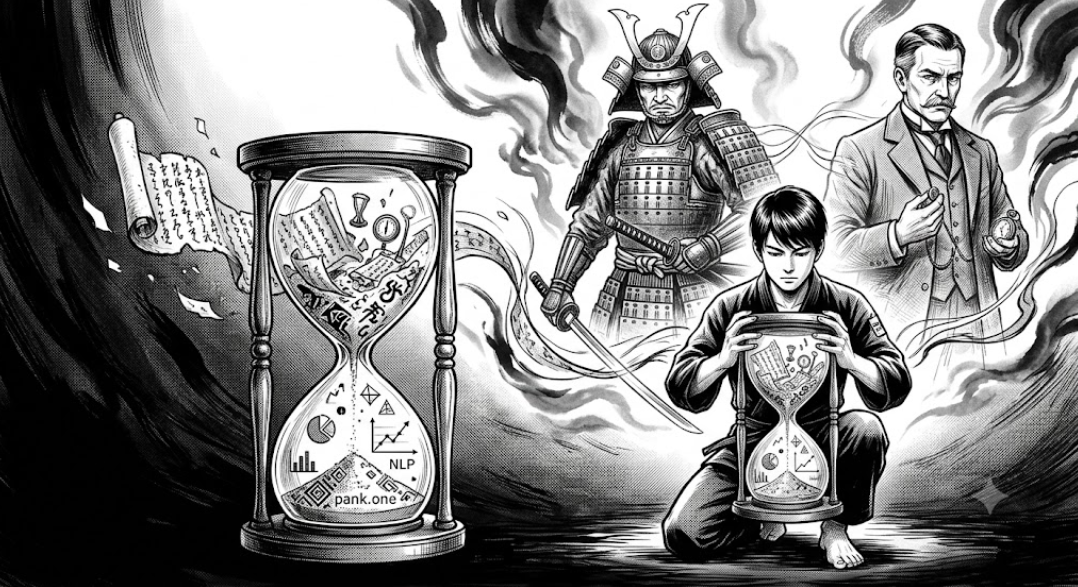
Hier, je discutais avec un ami et nous parlions de l’importance de la recherche historique dans la démarche d’apprentissage et de la nécessité d’affiner nos connaissances actuelles. En hypnose ou dans les arts martiaux, remonter aux origines est pour moi une forme de respect envers ceux qui ont élaboré ces systèmes de pensée, mais cela offre aussi la possibilité de mieux comprendre ce que nous appliquons parfois instinctivement au quotidien.
Lors d’une discussion avec Lee, nous échangeions par exemple sur la manière dont la PNL (Programmation Neuro-Linguistique) a pu s’insérer dans les modèles plus actuels d’accompagnement ou de coaching. C’est comme si l’identité spécifique de la discipline et son histoire s’étaient évaporées pour s’intégrer dans de nouvelles approches.
En réétudiant l’histoire, qu’il s’agisse de la discipline ou de ses techniques, nous pouvons mieux comprendre la façon dont elles ont été conçues et pourquoi l’usage que nous en faisons aujourd’hui ne correspond pas toujours aux objectifs vertueux pour lesquels elles ont été créées.
Nous pouvons ainsi mieux analyser pourquoi certains aspects restent efficaces aujourd’hui et pourquoi d’autres n’ont plus d’intérêt. L’évolution des connaissances a simplement permis de substituer les faits aux croyances, ouvrant des alternatives qui viennent à la fois désagréger l’héritage et, paradoxalement, le faire vivre sous de nouvelles formes.
Prenez ce qui est bon et juste pour vous. Be One, Pank. https://www.pank.one/blog
—
Reflections by Pank / Snapshot No. 624: Historical Analysis of Disciplines: Balancing Heritage, Evolution, and Pragmatism
Yesterday, during a discussion with a friend, we reflected on the significance of historical research within the learning process and its role in refining contemporary knowledge. Whether in hypnosis or martial arts, tracing a discipline back to its origins constitutes a mark of respect toward the pioneers of these conceptual systems. Furthermore, it provides valuable insights into practices we often apply intuitively in our daily lives.
In a conversation with Lee, we discussed how Neuro-Linguistic Programming (NLP) has been integrated into modern coaching and therapeutic frameworks. It appears as though the specific identity and historical narrative of the discipline have faded, blending seamlessly into contemporary methodologies.
By re-examining the history of both the disciplines and their underlying techniques, we can better understand their original design and discern why current applications may diverge from their foundational objectives.
This historical perspective allows us to evaluate why certain components retain their efficacy today while others have become obsolete. Advances in empirical understanding have shifted the paradigm from belief-based assumptions to evidence-based facts, thereby opening alternative avenues that simultaneously deconstruct traditional heritage and paradoxically sustain it through new iterations.
Take what is good and right for you. Be One, Pank. https://www.pank.one/blog
 Laboratoire Hypnose