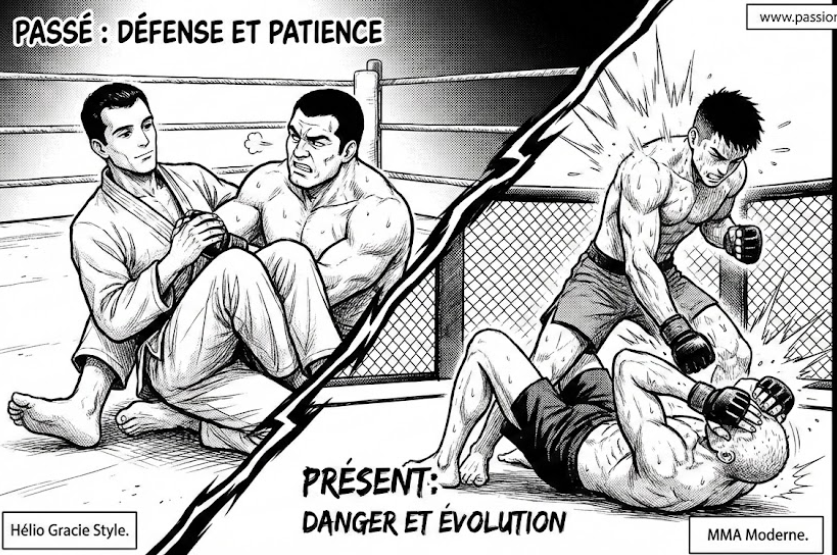
Comme beaucoup de combattants de MMA, quand j’ai commencé à combattre après la découverte du Jiu-Jitsu, je voulais me retrouver dos au sol pour placer un triangle ou un jujigatame (clé de bras). De plus, en France, au début de la pratique, les percussions au visage au sol étaient très rarement autorisées.
Comme pour beaucoup de pratiquants, le combat depuis la garde (sur le dos) était pour moi l’élément différenciateur du Jiu-Jitsu. Avec les années, ma réflexion autour du combat de rue, et plus encore avec l’évolution du MMA, a changé : l’idée d’être sur le dos n’était plus du tout ce que je souhaitais. Je savais même qu’avec certains types de combattants, cela pourrait s’avérer très complexe.
Pourtant, en compétition IBJJF/CFJJB, s’il ne se passe pas grand-chose, c’est souvent le combattant qui est dessous (c’est-à-dire en garde) qui obtiendra la décision arbitrale. Je me demandais pourquoi. Dans les différents textes que je lis sur le BJJ, la Luta Livre et le Catch Wrestling, il y a peut-être une réponse.
Rappelez-vous que les combats jusqu’aux années 70 ressemblaient au Judo et pouvaient même accepter le principe du tombé de la lutte (pin). Les frères Gracie, et surtout Hélio, suivaient la doctrine de self-défense de Carlos, son aîné. C’est notamment parce qu’il n’était pas bon en Tachi Waza (debout en mode projection). Du coup, il tirait la garde et la fermait, sachant que les combats pouvaient souvent durer plusieurs rounds de 10 minutes (sur ring).
Il n’y avait pas de frappes ; les combats de Vale Tudo jusqu’aux années 50-60 étaient assez rares. Par conséquent, il fatiguait les adversaires qui étaient souvent des spécialistes de projection et de contrôle. Les combats finissaient majoritairement en match nul (draw) ou par des soumissions de la part d’Hélio.
Il est possible que Carlos Jr, avec les règles du Jiu-Jitsu sportif, ait voulu mettre en valeur ce qui fait la vraie différence du Jiu-Jitsu par rapport aux autres styles de préhension, en favorisant les combattants qui tirent la garde. Rappelez-vous que la première génération de pratiquants de Jiu-Jitsu Gracie n’était pas bonne du tout debout ; d’où, comme en Kosen Judo, le développement du sol.
Prenez ce qui est bon et juste pour vous. Be One, Pank. https://www.passioncombat.net/
—
Martial Reflections of an Hypnofighter #497: Guard Retention in Jiu-Jitsu
Like many MMA fighters, when I started fighting after discovering Jiu-Jitsu, I wanted to end up on my back on the ground to set up a triangle choke or a jujigatame (armbar). Furthermore, in France, in the early days of the practice, strikes to the face on the ground were very rarely allowed.
For me, like many practitioners, fighting from the guard (on one’s back) was the differentiating element of Jiu-Jitsu. Over the years, my reflections on street fighting, and even more so with the evolution of MMA, changed: the idea of being on my back was no longer what I wanted at all. I even knew that against certain types of fighters, it could prove very complex.
However, in IBJJF/CFJJB competition, if not much is happening, it is often the fighter underneath (i.e., in guard) who will get the referee’s decision. I wondered why. In the various texts I read on BJJ, Luta Livre, and Catch Wrestling, there might be an answer.
Remember that fights up until the 70s resembled Judo and could even accept the wrestling principle of the pin. The Gracie brothers, and especially Helio, followed the self-defense doctrine of Carlos, his elder brother. This was notably because he was not good at Tachi Waza (standing throws). Therefore, he pulled guard and closed it, knowing that fights could often last for several 10-minute rounds (in a ring).
There were no strikes; Vale Tudo fights until the 50s and 60s were quite rare. Consequently, he tired out opponents who were often specialists in throws and control. The fights mostly ended in a draw or with submissions by Helio.
It is possible that Carlos Jr., with sporting Jiu-Jitsu rules, wanted to highlight what makes the true difference of Jiu-Jitsu compared to other grappling styles by favoring fighters who pull guard. Recall that the first generation of Gracie Jiu-Jitsu practitioners was not good at all standing up; hence, just like in Kosen Judo, the development of ground fighting.
Take what is good and right for you. Be One, Pank. https://www.passioncombat.net/



 Laboratoire Hypnose