
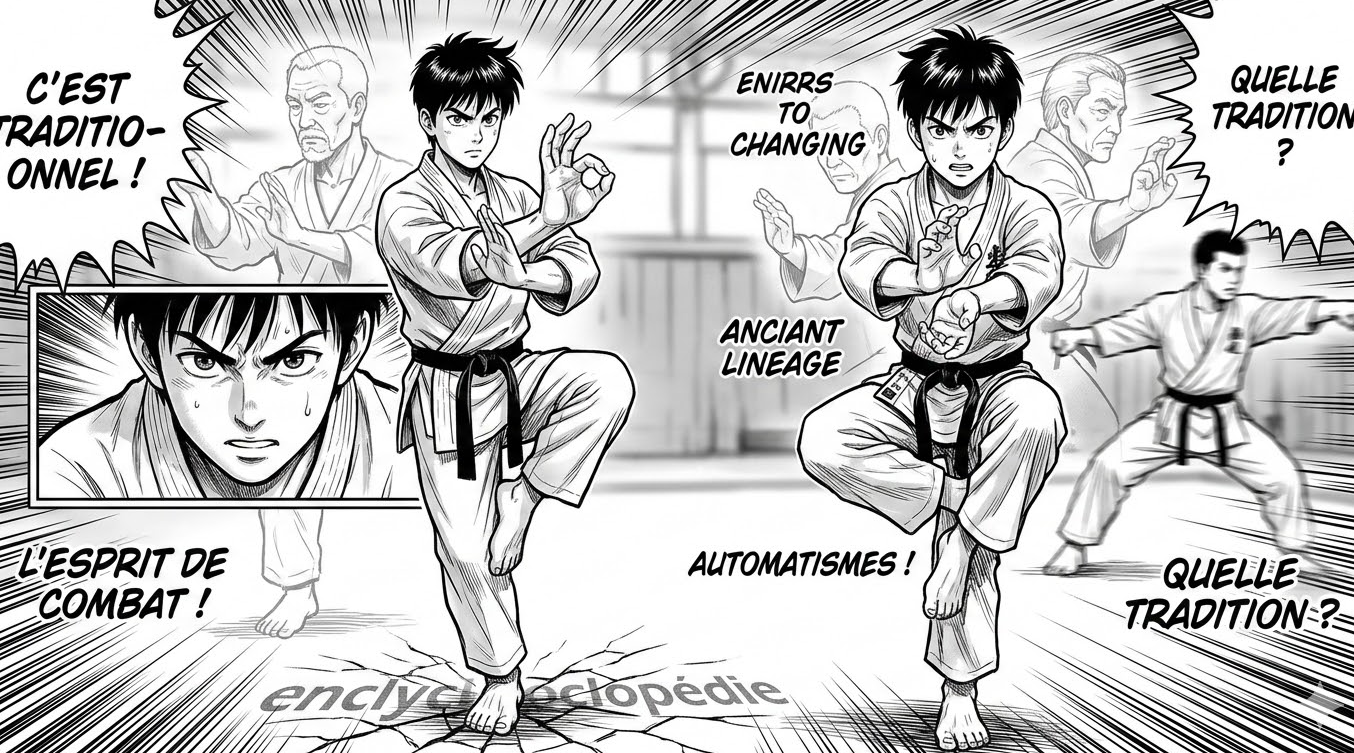
Les formes et les Kata. S’il y a une chose qui m’a particulièrement agacé au fur et à mesure de ma pratique du karaté quand j’étais plus jeune, ce sont les kata. Non pas que l’idée de répéter seul des techniques dans un format prédéterminé me dérange. Ce qui me dérangeait le plus, c’était le discours environnant.
Même si nous sommes bien d’accord que ce qui importe, c’est la pratique que l’on met en place et l’esprit de combat qu’on inclut dans notre kata, je ne cessais d’entendre qu’il fallait que je mette la main de cette façon-là, à cette hauteur-là, dans cette forme-là.
On me disait que c’était traditionnel, qu’il ne fallait pas faire autrement. Je n’aimais pas particulièrement le kata, mais je travaillais dessus et, par moments, notamment quand je n’avais personne avec qui m’entraîner, cela me permettait de passer de bons moments. Un jour, je me suis dit que j’allais faire une compétition de karaté. Étant donné que je pratiquais un style mineur, quand je m’y suis rendu, je ne savais absolument pas à quoi m’attendre.
Une fois que j’ai vu les autres participants faire des katas officiellement identiques à ceux de mon style, je me suis aperçu que cela n’avait rien à voir. Bien sûr, je savais que les styles sont différents, qu’il y a des interprétations des postures, mais là, c’étaient carrément les formes qui changeaient. Alors, j’en parlais régulièrement à mes professeurs qui me disaient : « Oui, mais nous, dans notre école à nous, c’est comme ça. »
Et puis, j’ai rencontré un grand maître de notre école. Lui-même, dans la forme qu’il nous proposait pendant un stage, n’utilisait pas la même forme que celle que mon école — donc la sienne — m’avait enseignée. Et quand j’ai posé la question à l’un de ses assistants, il a répondu qu’il avait repris une forme plus ancienne.
Du coup, quand j’entends « Oui, mais c’est traditionnel », il faudrait peut-être expliquer ou dire à quel moment la tradition a commencé. Il y a 5 ans, 10 ans, 20 ans, 50 ans, 100 ans ? Et si on nous embête sur un doigt ou un angle de jambe, est-ce que cela a réellement de l’importance, sachant que c’est une encyclopédie qui doit nous permettre de nous préparer éventuellement à des phases de combat et de créer des automatismes ?
Prenez ce qui est bon et juste pour vous. Be One, Pank.https://www.passioncombat.net/
—
Martial Reflections of an Hypnofighter #528: Does Tradition Freeze Movement? A Reflection on Forms and Kata
Forms and Kata. If there is one thing that particularly annoyed me during my karate practice when I was younger, it was kata. It’s not that the idea of repeating techniques alone in a predetermined format bothers me. What bothered me the most was the discourse surrounding it.
While we agree that what matters is the practice we put in place and the fighting spirit we include in our kata, I kept hearing that I had to place my hand this way, at this height, in this form. I was told it was traditional, and that it should not be done otherwise.
I didn’t particularly like kata, but I worked on it, and at times, especially when I had no one to train with, it allowed me to have some good moments. One day, I decided to enter a karate competition. Given that I practiced a minor style, when I arrived, I had absolutely no idea what to expect.
Once I saw the other participants performing katas that were officially the same as those in my style, I realized they had nothing in common. Of course, I knew styles are different, that there are interpretations of stances, but here, the forms themselves were changing. So, I regularly spoke to my teachers, who said, « Yes, but in our school, this is how it is. »
And then, I met a grandmaster from our school. He himself, in the form he proposed during a seminar, did not use the same form that my school—and therefore his—had taught me. And when I asked one of his assistants, he said that he had taken up an older form.
Consequently, when I hear « Yes, but it’s traditional, » perhaps we should explain or say when the tradition began. 5 years ago, 10 years, 20 years, 50 years, 100 years? And if we are nagged about a finger or a leg angle, does it really matter, knowing that it’s an encyclopedia meant to eventually prepare us for combat phases and create automatisms?
Take what is good and right for you. Be One, Pank.
 Laboratoire Hypnose