Réflexions martiales d’un Hypnofighter #479 : La Puissance de la Projection

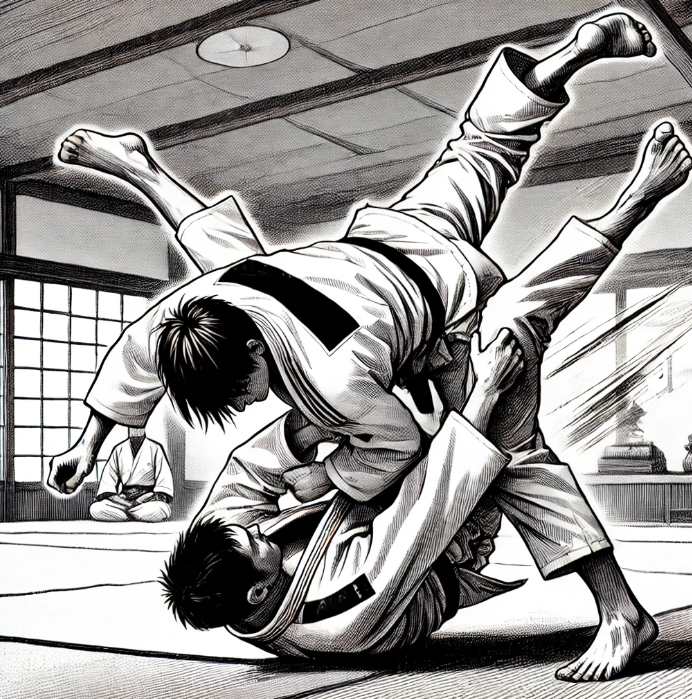
Nous le savons tous, la projection, à l’inverse du takedown, a pour but de percuter le sol. Nous savons que tomber est une chose dangereuse pour tous les combattants, soit parce qu’il peut y avoir une avalanche de frappes après, soit parce qu’un adversaire gère le sol, soit parce que nous pouvons être blessé et difficilement continuer à nous défendre.

C’est le cas de ce combat de championnat que nous avons eu cette nuit, avec le bras qui semble s’être disloqué (le combat vient de se finir, nous n’avons pas d’informations pour le moment), et donc le combat s’est terminé sur abandon. Si vous regardez souvent le MMA, il y a peut-être une chose qui vous marque depuis des années : la tension que beaucoup de combattants mettent sur leur bras pour scrambler directement et ne pas rester au sol.

Et si nous savons une chose dans les ukemis, c’est d’absorber plutôt que de bloquer l’impact. Le souci, sur des angles moins courants, c’est que notre corps ne supporte pas la pression sur le membre ou la partie qui est impactée au sol. Le match de Merab est en cours et il se fait casser par Yan. À un moment, Merab lève complètement son opposant et le met sur l’épaule pour le planter au sol.

Seulement, ce type de projection attendu et sur un sol de cage n’est pas assez effectif pour empêcher son opposant de tranquillement se relever et retourner en pied-poings. Nos lutteurs, samboïstes ou judokas en MMA ne parviennent pas toujours à faire mal sur la projection, parce que parfois l’impact recherché ne donne pas de résultat et l’effort effectué n’amène pas de contrôle ou de position forte.

C’est vraiment une arme potentiellement intéressante mais pas assez peaufinée pour la cage ou même le grappling, où les hors-combats sur projection sont très rares.

Prenez ce qui est bon et juste pour vous. Be One, Pank. https://www.passioncombat.net/

Martial Reflections of an Hypnofighter #479: The Power of the Projection

We all know that projection, unlike a takedown, aims to hit the ground. We know that falling is a dangerous thing for all fighters, either because there can be an avalanche of strikes afterwards, or an opponent who controls the ground, or because we can get injured and find it difficult to continue defending ourselves.

This was the case in the championship fight we had last night, with the arm appearing to be dislocated (the fight has just ended, we have no information for the moment), and so the fight ended in a submission. If you often watch MMA, there might be one thing that has stood out to you for years: the tension that many fighters put on their arms to scramble directly and not stay on the ground.

And if we know one thing in ukemis, it’s to absorb rather than block the impact. The problem, with less common angles, is that our body cannot withstand the pressure on the limb or part that is impacted on the ground. Merab’s match is ongoing and he’s getting broken by Yan. At one point, Merab completely lifts his opponent and puts him on his shoulder to slam him to the ground.

However, this type of expected projection on a cage floor is not effective enough to prevent his opponent from calmly getting back up and returning to striking. Our wrestlers, Sambo practitioners, or judokas in MMA do not always manage to inflict damage with a projection, because sometimes the desired impact does not yield results and the effort made does not lead to control or gaining a strong position.

It’s really a potentially interesting weapon but not refined enough for the cage or even grappling, where knockouts from projections are very rare.

Take what is good and right for you. Be One, Pank. https://www.passioncombat.net/

Réflexions martiales d’un Hypnofighter #457 : L’Impact des Projections au Sol

Le dernier UFC a rappelé un élément martial important, parfois oublié dans une dynamique sportive. Almeida a pu emmener Volkov au sol comme il le souhaitait. On peut valoriser cette capacité à maîtriser un adversaire au sol, un peu comme on l’a mis en avant durant la période « self-defense » du Gracie Jiujitsu.

Seulement, si une fois au sol je ne finalise pas, et dans une configuration de combat urbain, outre le danger d’être à terre, il n’est pas si simple de placer une clé ou un étranglement lorsque l’opposant/agresseur bouge dans tous les sens pour se relever, soit pour fuir, soit pour reprendre l’attaque.

On a observé la même chose au niveau sportif : pas de soumission, mais pire, pas de percussions. Au final, le Brésilien perd son match alors qu’il a contrôlé. Et c’est là que l’on peut revenir aux origines du BJJ, le Kodokan Judo. En Judo, on parle de projection : on cherche à faire percuter l’opposant au sol.

Cette frappe complexe que peuvent être ces techniques de projections, autant dans la rue qu’en cage, peut tout changer. Si vous avez déjà chuté dans la rue, sur une plaque de glace – et je ne parle pas des accidents de vélo ou de trottinette – vous avez possiblement ressenti quelques douleurs et peut-être même vous vous êtes blessé. Si vous avez eu la chance d’être sur des tatamis avec de bons judokas ou lutteurs, là aussi, même si on est sur un tatami, préparé avec nos connaissances des ukemis (brise-chute), on peut subir un choc important et se retrouver amoindri en énergie, voire assommé.

En MMA, il faut choisir : soit on veut montrer une efficience de l’amenée au sol en faisant percuter avec une projection, soit accepter que le takedown soit « inoffensif » mais qu’ensuite, il faille frapper ou soumettre l’opposant pour marquer les juges sur l’efficacité de cette phase de combat.

Un questionnement stratégique en fonction des disciplines initiales des combattants.

Prenez ce qui est bon et juste pour vous. Be One, Pank. https://www.passioncombat.net/

Martial Reflections of a Hypnofighter #457: The Impact of Takedowns

The last UFC reminded us of an important martial element sometimes forgotten in a sporting dynamic. Almeida was able to take Volkov to the ground as he wished. We can value this ability to take an opponent to the ground, much like it was promoted during the « self-defense » period of Gracie Jiujitsu.

However, if once on the ground I don’t submit, and in an urban combat setting, besides the danger of being on the ground, it’s not so simple to apply a lock or choke when the opponent/aggressor is moving frantically to get back up, either to flee or to resume the attack.

We saw the same thing in sports: no submission, but worse, no strikes. In the end, the Brazilian lost his match despite having controlled it. And this is where we can return to the origins of BJJ, Kodokan Judo. In Judo, we talk about projections: we seek to make the opponent hit the ground.

This complex strike that these projection techniques can be, both in the street and in the cage, can change everything. If you have ever fallen in the street, on a patch of ice – and I’m not talking about bicycle or scooter accidents – you have likely felt some pain and perhaps even injured yourself. If you have been fortunate enough to be on tatami mats with good judokas or wrestlers, even there, even if we are on a tatami, prepared with our knowledge of ukemis (breakfalls), we can take a big shock and find ourselves diminished in energy, or even knocked out.

In MMA, one must choose: either one wants to demonstrate the efficiency of a takedown by making the opponent hit the ground with a projection, or accept that the takedown is « inoffensive » but that afterward, one must strike or submit the opponent to impress the judges on the effectiveness of this combat phase.

A strategic questioning depending on the initial disciplines of the fighters.

Take what is good and right for you. Be One, Pank. https://www.passioncombat.net/
Réflexions martiales d’un Hypnofighter #440 : L’art du Grappler-Frappeur

Il y a parfois une confusion, notamment parce que la plupart des grapplers à l’UFC se rendent compte que l’on peut achever un combat plus « facilement » avec un gros overhand. Et si, pour une raison ou une autre, un combattant possède une puissance de KO (KO power), on se retrouve avec des athlètes comme Gilbert Burns, Yoel Romero ou même Kamaru Usman, qui ont mis en retrait leurs qualités de grappleur au profit de la frappe.

Pourtant, ce qui est possible, au-delà de l’attente médiatique suscitée par les professionnels, c’est de développer le grappling avec frappes. On sait que des organisations comme le Jiujitsu Combat encouragent les frappes non pas pour le KO, mais pour brouiller le jeu, pour faciliter le clinch, pour provoquer une réaction menant au takedown ou, finalement, à une soumission.

Il y a maintenant une recherche de boxe au sol (ground and pound) pour créer un KO, car la soumission est difficile et épuisante, d’autant plus avec des combattants toujours plus physiques. Mais là encore, développer une boxe de grappler pour faire lâcher, pour épuiser, pour rendre, round après round, le travail de frappe de l’opposant inefficace est une option viable.

Dans nos disciplines de grappling, que ce soit la Luta Livre, le BJJ (Jiu-Jitsu Brésilien) ou le Judo, l’ajout de ce facteur de frappes « simplifie » certaines actions, ouvre les jeux trop rétentionnistes, mais développe aussi une approche intéressante quant à nos réponses techniques et nettoie beaucoup de systèmes qui ne peuvent plus exister si les frappes sont autorisées.

Pour moi, un grappler doit être apte à gérer les frappeurs (ce qui lui vaudra quelques belles ecchymoses en fonction du niveau de l’opposant) et être conscient que les frappes transforment tout. Il doit aussi savoir utiliser ces mêmes armes disponibles pour peaufiner un grappling plus « réaliste » et complet.

Il n’y a pas besoin de grosses frappes lourdes pour voir l’impact que cela peut avoir. Ajoutez à quelques randori des clappes ou tapes (baffes légères) depuis le combat en tachi waza (debout), et vous verrez que même des gradés pourraient ne pas avoir la réaction la plus juste pour mener vers leur zone de compétence.

Prenez ce qui est bon et juste pour vous.

Be One,

Pank

Martial Reflections of a Hypnofighter #440: Strikers Who Grapple

There is sometimes confusion, particularly because most UFC grapplers realize that a fight can be finished more « easily » with a big overhand. And if, for one reason or another, a fighter possesses KO power, you end up with athletes like Gilbert Burns, Yoel Romero, or even Kamaru Usman, who have largely abandoned their grappling skills in favor of striking.

However, what is possible, outside of the media hype surrounding pros, is to develop grappling with strikes. Organizations like Jiujitsu Combat are known to encourage striking, not for the KO, but to disrupt the opponent’s game, to facilitate the clinch, to provoke a reaction leading to a takedown or, ultimately, to a submission.

There is now a focus on ground and pound to secure a KO, because submitting an opponent is difficult and exhausting, especially with increasingly physical fighters. But even here, developing a grappler’s striking game—to make the opponent let go, to exhaust them, to render the opponent’s striking work ineffective round after round—is a viable option.

In our grappling systems, whether it’s Luta Livre, BJJ (Brazilian Jiu-Jitsu), or Judo, adding this « strike factor » simplifies certain actions, opens up overly defensive games, but also develops an interesting approach regarding our technical responses and cleans up many systems that can no longer exist if strikes are permitted.

To me, a grappler must be able to deal with strikers (which will earn them a few good bruises depending on the opponent’s level) and be aware that strikes transform everything. They must also know how to use these same available weapons to refine a more « realistic » and complete grappling game.

You don’t need heavy, powerful strikes to see the impact this can have. Add a few taps or light slaps to some randori (free practice) from the tachi waza (standing) combat, and you’ll see that even high-ranking practitioners might not have the most appropriate reaction to transition to their area of expertise.

Take what is good and right for you.

Be One,

Pank

Réflexions Martiales d’un Hypnofighter #320 : Chacun sa spécialité

Le BJJ est issu du Judo, mais se distingue par sa spécialisation unique dans le combat au sol. Contrairement au Judo ou au Sambo, où le sol est secondaire, le BJJ considère le combat au sol comme son essence. Découvrez pourquoi cette différence fait du Jiujitsu une discipline unique en grappling.

Nous le savons, le BJJ est un cousin, voire un descendant direct du Judo. Le Sambo également, et les luttes diffèrent tellement en fonction de leurs origines. Cependant, une chose est certaine : le combat au sol n’est que sporadique dans toutes les disciplines, à l’exception du Jiujitsu et éventuellement du Kosen Judo.

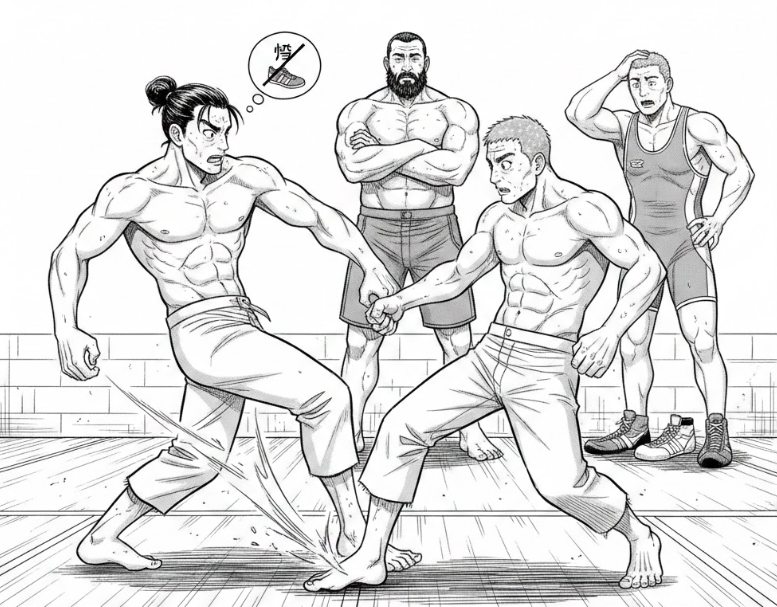
Lorsque je partage des techniques de takedown en cours, il m’arrive souvent de comparer celles proposées en Judo ou en Sambo, en partant du postulat que ces disciplines sont spécialisées dans les projections, mais beaucoup moins dans le travail au sol. Pourquoi ? Simplement parce qu’au début du XXe siècle, les professeurs considéraient qu’un combattant au sol, surtout après une grosse projection, serait neutralisé (KO).

Je ne reviendrai pas sur l’évolution sportive qui a encore renforcé cette idée. Le sol a été intégré au Judo avec le Fusen Jiujitsu, et le Sambo a en partie repris les logiques du ne-waza du Judo avec une orientation marquée sur les clés de jambe. Le BJJ, quant à lui, a été créé sans chercher à suivre les objectifs militaires ou policiers du Judo/Sambo, et s’est rapidement orienté de la défense personnelle vers la confrontation interstyle.

Ainsi, entre l’approche technique de Carlos et les spécificités physiques d’Helio, le Gracie Jiujitsu s’est concentré de plus en plus sur le combat au sol. Quand on veut comparer les styles de grappling au sol, il est évident qu’aucun style n’est aussi spécialisé dans cet aspect que le Jiujitsu. Même si les autres disciplines incluent le travail au sol, ce n’est que pour compléter ou compenser une projection « trop faible », alors qu’en BJJ, le combat commence véritablement au sol.

Les takedowns en BJJ doivent donc être perçus comme une simple transition vers la position qui permettra le « vrai » travail de la discipline : le combat au sol.

Prenez ce qui est bon et juste pour vous.

Be One,
Pank

Martial Reflections of a Hypnofighter #320: Everyone Has Their Specialty

We know that BJJ is a cousin—or even a direct descendant—of Judo. The same applies to Sambo, and grappling styles vary significantly depending on their origins. However, one thing is certain: ground fighting is only sporadically practiced in all disciplines except for Jiujitsu and, perhaps, Kosen Judo.

When I teach takedown techniques, I often compare those found in Judo or Sambo, starting from the premise that these disciplines are specialized in throws but not in ground fighting. Why? Simply because, at the beginning of the 20th century, instructors believed that a fighter on the ground, especially after a major throw, would be neutralized (KO).

I won’t dwell on how sports competition has further reinforced this notion. Ground techniques were integrated into Judo via Fusen Jiujitsu, and Sambo partially adopted Judo’s ne-waza logic, focusing on leg locks. BJJ, on the other hand, was created without aiming to follow the more military or police-oriented goals of Judo/Sambo. It quickly transitioned from self-defense to interstyle confrontation.

Thus, between Carlos’ technical approach and Helio’s physical attributes, Gracie Jiujitsu has increasingly emphasized ground fighting. When comparing grappling styles on the ground, it becomes clear that no style is as specialized in this area as Jiujitsu. While other disciplines include ground work, it’s typically to complement or compensate for a “weaker” throw, whereas in BJJ, the fight only truly begins on the ground.

Therefore, BJJ takedowns should be viewed merely as a transition into position before the discipline’s “real” focus: ground fighting.

Take what resonates with you and what serves you best.

Be One,
Pank

Réflexions Martiales d’un Hypnofighter #318 : Mérab vs Uman

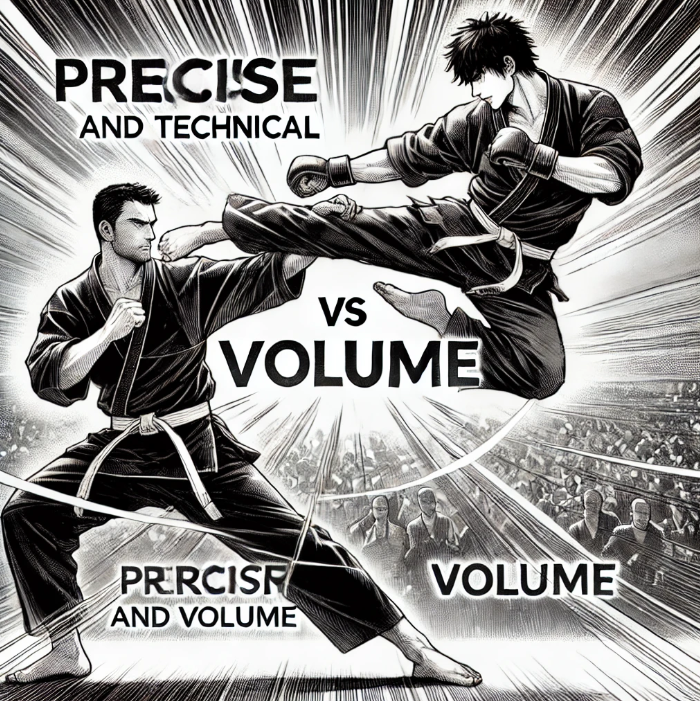
Le combat entre Mérab et Uman a démontré que le cardio et le volume de frappes peuvent surpasser la technique pure. Malgré la supériorité technique d'Uman, Mérab a su imposer un rythme constant, forçant son adversaire à faiblir au fil des rounds. Une réflexion sur l'importance du physique dans le MMA.

Cette nuit, le combat entre les deux protagonistes a montré à quel point le cardio et le volume restent des éléments cruciaux dans un combat. Je voyais Uman techniquement meilleur, mais j’apprécie la façon de combattre de Mérab, ce qui me faisait penser que si Uman parvenait à percuter fort et à mettre un down ou un KO dans les deux premiers rounds, il pourrait gagner.

Cependant, même si dans un premier temps les percussions du Russe étaient plus précises et impactantes que celles de Mérab, ce dernier, bien qu’un peu rougi, n’a pas eu d’élément qui aurait pu enrayer sa machine. Ainsi, round après round, il reprenait son action : avancer et agresser sans cesse avec un volume impressionnant en frappes et en takedowns.

C’est à ce moment que nous avons pu voir que, même si la technique d’Uman est exceptionnelle, le fait qu’un combattant ne cesse de provoquer du stress et des actions de plus en plus dangereuses sans montrer de signes d’essoufflement physique finit par avoir un impact.

La précision des techniques diminue, tout comme la justesse et le timing. En face, même s’il y a moins de frappes belles et puissantes, celles qui passent s’accumulent. Certes, elles ne causent pas de dégâts immédiats, mais leur cumul ne peut être ignoré.

C’est souvent pour cette raison que les athlètes de MMA moyens – je ne parle pas des élites – sont souvent assez pauvres techniquement. Ils maîtrisent quelques combinaisons, mais surtout, ils possèdent des physiques extraordinaires. Car il faut se rappeler que les arts martiaux sont des jeux de force, et que le physique est déterminant, surtout lorsque le temps d’opposition s’étend.

Prenez ce qui est bon et juste pour vous.

Be One,

Pank

Martial Reflections of a Hypnofighter #318: Mérab vs Uman

Last night, the fight between the two protagonists demonstrated how crucial cardio and volume are in combat. I saw Uman as technically superior, but I appreciated Mérab’s fighting style, which led me to think that if Uman landed a strong strike and scored a knockdown or KO in the first two rounds, he could win.

However, even though the Russian’s strikes were initially more precise and impactful than Mérab’s, the latter, despite some visible wear, showed no signs of being slowed down. Round after round, he kept pushing forward and relentlessly attacking with a high volume of strikes and takedowns.

At this point, we saw that even though Uman’s technique was outstanding, the constant stress and increasingly dangerous actions caused by an opponent who seemed inexhaustible began to take their toll.

The precision of Uman’s techniques declined, as did his timing and accuracy. Meanwhile, Mérab, despite landing fewer clean and powerful strikes, kept connecting. Though his strikes didn’t cause immediate damage, their cumulative effect could not be ignored.

This is often why mid-level MMA athletes – not the elites – are generally less technically refined. They may master a few combinations, but above all, they have extraordinary physical conditioning. Martial arts, after all, are contests of strength, and physicality becomes decisive, especially in prolonged matches.

Take what is good and right for yourself.

Be One,

Pank