
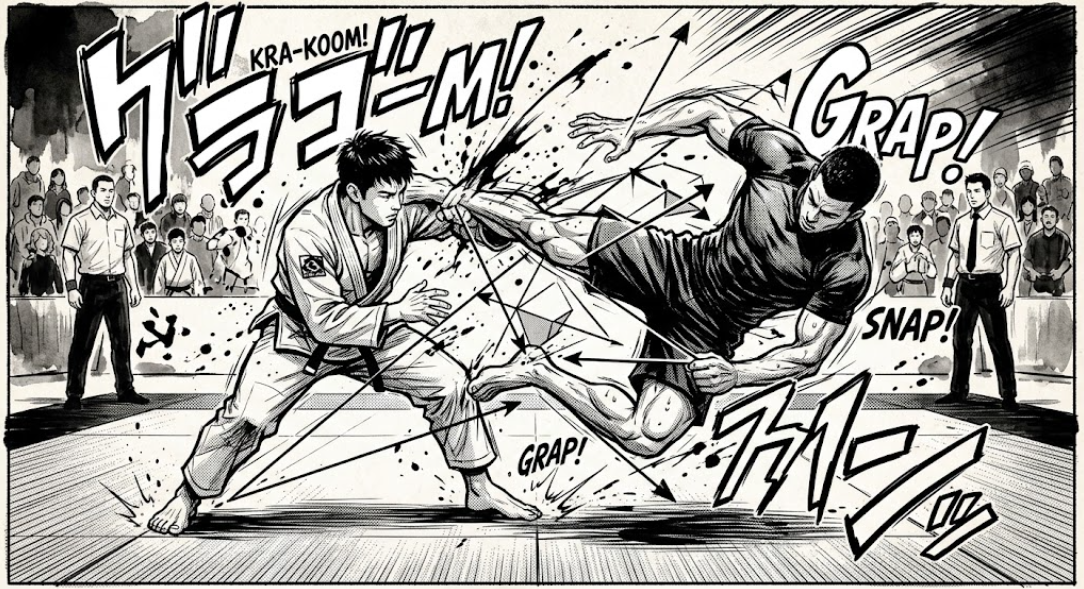
Avec l’ADCC, une chose m’a marqué : le passage d’un système de leglocks ultra-intellectualisé et révolutionnaire il y a six à sept ans — sous l’impulsion de John Danaher (ou d’Eddie Cummings, mais soit…) — à ce que nous observons aujourd’hui chez l’élite de notre discipline en grappling.
Aujourd’hui, loin du principe essentiel du jiu-jitsu qui met l’accent sur la posture pour soumettre, la forme actuelle ressemble davantage à celle du shooto et du sambo de la fin des années 1990 : le grip offre une perspective permettant de s’adapter pour trouver le meilleur angle possible. La différence majeure réside dans la forme physique et les qualités athlétiques exceptionnelles des combattants actuels.
Cela donne des combats articulés autour de logiques assez éloignées du jiu-jitsu pur, même si les phases de combattants comme Kaynan Duarte ou Kennedy Maciel rappellent les fondamentaux de la discipline. De plus, le combat debout ne relève plus de la lutte pure, mais d’un grappling spécifique dont les bons lutteurs n’arrivent pas à exploiter les ouvertures.
Pourquoi ? Parce que le grappling debout est devenu très passif et opportuniste. Les combattants rompent le contact et reculent, une attitude sanctionnée en judo ou en lutte, mais ici tolérée.
Le grappling affirme ainsi une identité propre, marquée par une synthèse des disciplines de préhension et par l’usage de soumissions qui restent interdites dans les tournois classiques de l’IBJJF.
Prenez ce qui est bon et juste pour vous. Be One, Pank. https://www.passioncombat.net/
—
Martial Reflections of an Hypnofighter #627 : The Technical and Tactical Evolution of Modern Grappling: From the Leglock Revolution to a Hybrid Athletic Synthesis
With the ADCC, one striking observation emerges: the transition from an ultra-intellectualized and revolutionary leglock system six to seven years ago—spearheaded by John Danaher (or Eddie Cummings, for that matter)—to the current dynamics observed among the elite of our discipline in submission grappling.
Today, rather than adhering to the foundational principle of Brazilian Jiu-Jitsu that emphasizes posture to achieve submission, the current meta aligns more closely with late-1990s Shooto and Sambo. In this framework, gripping dynamics provide tactical perspectives to adjust and locate optimal biomechanical angles. The primary divergence lies in the modern fighters’ physical conditioning and extraordinary athletic capacities.
This shift yields combat logic distinct from pure BJJ, despite fundamental principles remaining visible in phases executed by competitors like Kaynan Duarte or Kennedy Maciel. Furthermore, standing engagement no longer mirrors pure wrestling; it has evolved into a highly specialized form of grappling where traditional wrestlers struggle to exploit openings.
This occurs because standing grappling has become predominantly passive and opportunistic. Competitors frequently disengage from contact and retreat—tactics strictly penalized in Judo and Olympic wrestling, yet left unsanctioned here.
Grappling has thus established a distinct technical identity through a growing synthesis of combat gripping arts, combined with the integration of submissions that remain prohibited in conventional IBJJF tournaments.
Take what is good and right for you. Be One, Pank. https://www.passioncombat.net/

