
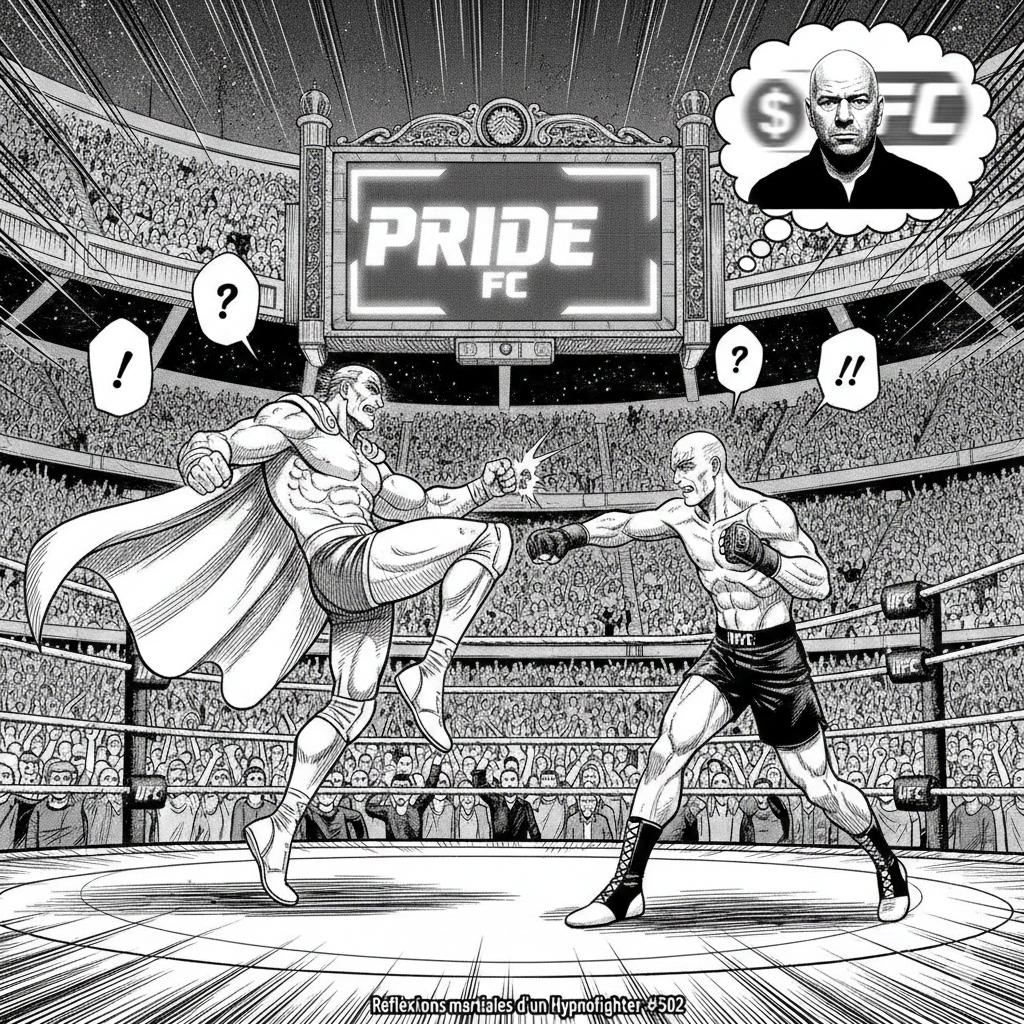
Réflexions martiales d’un Hypnofighter #502 : Le Pride FC avait tout compris

Est-ce parce qu’ils sont dans un pays où le Pro Wrestling, c’est-à-dire l’art des combats de divertissement, est monnaie courante ? Pour rappel, si nous avons mis en place des combats truqués ou simplement spectaculaires, c’est parce que les acheteurs de spectacles recherchent avant tout un bon moment. Ils n’attendent pas nécessairement une qualité pugilistique, technique ou tactique, mais plutôt une expérience émotionnelle agréable.

Quand on observe comment des stars sont « montées » en puissance, à l’instar de Paddy (qui reste très fort) ou d’un O’Malley (également un excellent striker), on comprend que ce qui est choisi par les « match makers » est ce qui pourrait attirer des spectateurs et générer des séquences marquantes à diffuser sur les médias sociaux.

Pendant le Pride FC, qu’on ait aimé ou non, outre les règles qui pouvaient facilement choquer les moins amateurs de Vale Tudo, les « Freak Fights » dont tout le monde se moquait sont encore régulièrement mis en avant par les algorithmes. De plus, la plupart des combats, même s’ils étaient mis en scène, apportaient de la reconnaissance autant pour les athlètes que pour l’organisation.

Ce lien avec le Pro Wrestling et le fait même que des « Catch Wrestlers » aient tenté leur chance dans des combats plus réels répondaient à un fantasme des spectateurs, développé depuis des décennies dans les mangas : savoir si un « catcheur » pouvait mettre en pratique ce qu’il faisait en combat « réel ».

Outre l’organisation titanesque, les salles incroyables et les combattants dangereux, avec des « match makings » complètement déséquilibrés mais générant un effet voyeuriste chez les spectateurs, le Pride FC est ce que l’UFC risque de devenir dans les décennies à venir.

La boxe anglaise a déjà cédé au monde du divertissement avant tout ; le MMA, tôt ou tard, verra sa popularité se réduire, et nous risquons, surtout avec le départ de Dana White, une réorientation de ce qu’est le MMA.

Prenez ce qui est bon et juste pour vous. Be One, Pank.

Martial Reflections of a Hypnofighter #502: Pride FC Understood Everything

Is it because they are in a country where Pro Wrestling, meaning entertainment fights, is commonplace? As a reminder, if we have implemented fixed or simply spectacular fights, it’s because show buyers primarily want to have a good time. They don’t necessarily expect pugilistic quality, technical or tactical, but rather an emotionally enjoyable experience.

When we see how stars are « built up, » like Paddy (who remains very strong) or O’Malley (also an excellent striker), we understand that what is chosen by matchmakers is what could attract spectators and generate big sequences for social media dissemination.

During Pride FC, whether you liked it or not, besides the rules that could easily shock less avid Vale Tudo fans, the « Freak Fights » that everyone mocked are still regularly highlighted by algorithms. Moreover, most fights, even if staged, brought recognition for both the athletes and the organization.

This link with Pro Wrestling and the very fact that Catch Wrestlers tried their luck in more real fights answered a spectators’ fantasy, developed for decades in manga: to know if a « wrestler » could practice what he did in « real » combat.

Beyond the colossal organization, incredible venues, and dangerous fighters, with completely unbalanced match-making that generated a voyeuristic effect on spectators, Pride FC is what the UFC risks becoming in the coming decades.

English boxing has already succumbed to the entertainment business above all; MMA, sooner or later, will see its popularity diminish, and we risk, especially with Dana White’s departure, a reorientation of what MMA truly is.

Take what is good and right for you. Be One, Pank.

Réflexions martiales d’un Hypnofighter #495 : Sakuraba, le maitre des double wristlock

Nous connaissons tous Sakuraba, légende de l’ancienne génération du MMA. Il a battu trois des Gracie à une époque où l’on pensait que les pratiquants de BJJ étaient les combattants les plus dangereux du circuit. Ce qui est cocasse, c’est que Billy Robinson, élève et champion de Catch-as-Catch-Can de Wigan (Le Snake Pit) – dont je vous ai déjà parlé comme étant l’un des enseignants des fédérations de Pro Wrestling japonaises – tenait un discours intéressant quant au Jiujitsu.

Il pensait que le Catch Wrestling avait manqué de chance parce que tous les bons combattants de la discipline étaient partis dans les circuits de Pro Wrestling pour l’argent, et que la facette martiale du style n’avait pas été autant enseignée qu’elle l’était au début du 20e siècle. Il estimait que les catch wrestlers avaient les clefs pour battre les Gracie lors des premières années de l’UFC et autres NHB.

Et il n’a pas eu tort, car Saku était son élève quand il a combattu la famille Gracie. Il ne faut pas oublier qu’il était déjà un bon lutteur avant d’être pro-wrestler. Et saviez-vous que la spécialité du catch wrestling de Robinson était le « double wristlock », autrement dit la Kimura, que Sakuraba a passée aux trois combattants brésiliens.

La chance n’a rien à voir là-dedans. L’histoire du BJJ comme du Catch Wrestling au Brésil a montré, sur des centaines de combats, que les deux écoles étaient assez équilibrées en termes de victoires jusqu’aux années 50-60. Les Jiujitsukas gagnaient souvent quand le kimono était obligatoire, tandis que les Catch wrestlers (les lutadores) remportaient souvent les combats sans gi.

Sakuraba a utilisé une technique qui était, à cette période, une faiblesse du jeu des Gracie. Il s’agit de l’une des principales attaques du Catch Wrestling, utilisable aussi bien debout (dans un formalisme de soumission ou de projection) qu’au sol. Au Pride, l’affrontement Gracie Jiujitsu vs Catch Wrestling n’était qu’une simple continuation d’une rivalité existant depuis 1915 entre les deux styles.

Prenez ce qui est bon et juste pour vous. Be One, Pank. https://www.passioncombat.net/

Martial Reflections of an Hypnofighter #495: Sakuraba, the Master of Double Wristlocks

We all know Sakuraba, a legend of the old MMA generation. He beat three of the Gracies at a time when BJJ practitioners were considered the most dangerous fighters on the circuit. What is funny is that Billy Robinson, a student and champion of Catch-as-Catch-Can from Wigan (The Snake Pit)—whom I have spoken to you about before as being one of the instructors for Japanese Pro Wrestling federations—had an interesting discourse regarding Jiujitsu.

He believed that Catch Wrestling had been unlucky because all the good fighters in the discipline had left for the Pro Wrestling circuits for the money, and that the martial facet of the style had not been taught as much as it was at the beginning of the 20th century. He estimated that catch wrestlers held the keys to beating the Gracies during the early years of the UFC and other NHB events.

And he was not wrong, because Saku was his student when he fought the Gracie family. We must not forget that he was already a good amateur wrestler before being a pro-wrestler. And did you know that Robinson’s catch wrestling specialty was the « double wristlock, » otherwise known as the Kimura, which Sakuraba successfully applied to the three Brazilian fighters.

Luck has nothing to do with this notion. The history of both BJJ and Catch Wrestling in Brazil showed, over hundreds of fights, that the two schools were fairly balanced in terms of victories up until the 50s and 60s. The Jiujitsukas often won when the kimono was mandatory, while the Catch wrestlers (the lutadores) often won the no-gi fights.

Sakuraba utilized a technique that was, at that period, a weakness in the Gracie game. It is one of the principal attacks of Catch Wrestling, usable both standing (in a submission or throw formalism) and on the ground. At Pride, the Gracie Jiujitsu vs. Catch Wrestling match was simply a continuation of a rivalry that had existed since 1915 between the two styles.

Take what is good and right for you. Be One, Pank. https://www.passioncombat.net/

Réflexions martiales d’un Hypnofighter #494 : Pourquoi des catcheurs au Pride et au Rizin ?

Vous le savez, le MMA au Japon est assez différent de ce que nous connaissons aux USA ou en Europe. Ils ont une culture des shows associés au Pro Wrestling. Si les compétitions de K1 et même de Kyokushin arrivaient à remplir des stades, c’est souvent grâce à l’influence que le Puroresu a eue sur la culture nippone.

Les trois grands styles de MMA qui se sont diffusés — le Pancrase, le Shooto et la Rings — ont été créés par des Pro Wrestlers comme Funaki, Sayama et Maeda. C’est pour cette raison qu’au départ, les combats étaient parfois truqués. L’idée de ces « showmen » était de rendre le spectacle de plus en plus réaliste avec des formes dites « shoot », utilisant des techniques portées pleinement, surtout sur les frappes au corps.

Mais pourquoi cette recherche de réalisme alors que la WWE nous a rarement sorti des combattants aptes pour l’UFC, mis à part Lesnar et Batista dans une moindre mesure ? Grâce à l’influence du Catch britannique de Karl Gotch et de Billy Robinson. Comme je vous le partageais dans ma dernière réflexion, ils ont dû passer d’une lutte à soumission amateur à une forme professionnelle : le Pro Wrestling.

Mais comme les combattants étaient avant tout de vrais pratiquants qui cherchaient à projeter et soumettre, la transition vers le show a été difficile, et surtout douloureuse pour les seuls showmen issus de la musculation. L’apport du Catch Wrestling de Wigan a poussé les Pro Wrestlers japonais à s’entraîner partiellement à ce style fort et réaliste.

Donner plus de réalisme aux combats posait la question de savoir s’ils étaient aussi capables d’être compétents sans la facette « show ». D’où les Minowaman (Minawa), Sakuraba ou Takada. Tous issus de dojos de Pro Wrestling coachés par les Britanniques qui les entraînaient en mode réaliste.

Je reviendrai dessus, mais un Saku est élève de Robinson qui avait sa spécialité en Catch-As-Catch-Can sur le « double wristlock »… la Kimura…

Prenez ce qui est bon et juste pour vous. Be One, Pank. https://www.passioncombat.net/

Martial Reflections of an Hypnofighter #494: Why Pro Wrestlers in Pride and Rizin?

As you know, MMA in Japan is quite different from what we know in the US or Europe. They have a culture of shows associated with Pro Wrestling. If K1 and even Kyokushin competitions managed to fill stadiums, it is often thanks to the influence that Puroresu had on Japanese culture.

The three great styles of MMA that spread — Pancrase, Shooto, and Rings — were created by Pro Wrestlers like Funaki, Sayama, and Maeda. This is why, initially, the fights were sometimes fixed (worked). The idea of these « showmen » was to make the spectacle increasingly realistic with so-called « shoot » forms, using techniques executed fully, especially body strikes.

But why this search for realism when the WWE has rarely produced fighters suitable for the UFC, apart from Lesnar and Batista to a lesser extent? Thanks to the influence of British Catch Wrestling from Karl Gotch and Billy Robinson. As I shared with you in my last reflection, they had to transition from amateur submission wrestling to a professional form: Pro Wrestling.

But since the fighters were first and foremost true practitioners seeking to throw and submit, the transition to « show » was difficult, and above all painful for showmen who only came from bodybuilding backgrounds. The contribution of Wigan’s Catch Wrestling pushed Japanese Pro Wrestlers to partially train in this strong and realistic style.

Giving more realism to the fights raised the question of whether they were also capable of being competent without the « show » facet. Hence the likes of Minowaman, Sakuraba, or Takada. All came from Pro Wrestling dojos coached by the British who trained them in a realistic mode.

I will return to this, but « Saku » (Sakuraba) is a student of Robinson, whose specialty in Catch-As-Catch-Can was the « double wristlock »… the Kimura…

ake what is good and right for you. Be One, Pank. https://www.passioncombat.net/