
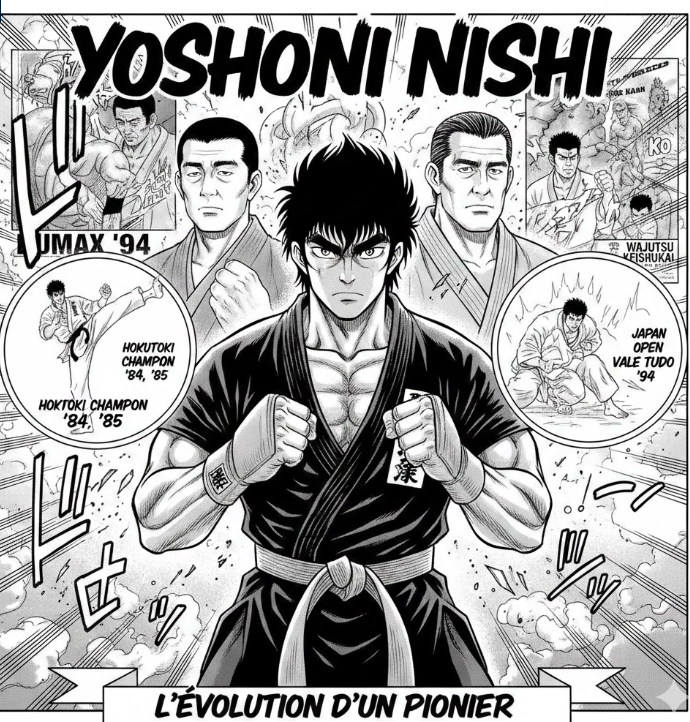
Vous ne vous souvenez probablement pas de ce combattant, d’autant plus si vous n’êtes pas un passionné de combat libre. En me penchant un peu sur le Daido Juku, ce karaté de Shihan Azuma qui est devenu le Kudo, je suis revenu sur les premiers pratiquants et champions. Nishi était l’un des grands de ce style, remportant en 1984 et 1985 le championnat Hokutoki.
Je reviendrai sur des éléments importants du Daido Juku, issu du Kyokushin, dans d’autres articles. Nishi a été formé au Judo par Kimura (la légende du Judo), puis rapidement au Kyokushinkai et surtout au Daido Juku vers 1983. Ce qui m’intéresse chez ce combattant, c’est qu’il a tenté de combattre dans des disciplines diverses. Il a notamment remporté le LUMAX, qui était déjà une sorte de MMA en tournoi, un peu comme l’UFC, en 1994. Quelques années auparavant, il avait combattu Rob Kaman (1990) en Kickboxing, où il subira un KO.
Il a été connu pour avoir affronté Rickson Gracie au premier Japan Open Vale Tudo de 1994. Il a rapidement perdu le match sans avoir pu s’exprimer. Ce qui est intéressant, c’est que la même année, nous avions un autre combattant du Daido Juku, d’ailleurs le premier Japonais à l’UFC, qui a perdu contre Royce Gracie : Minoki Ichihara.
Si Azuma a cherché en réponse à intégrer plus de sol et même à faire évoluer son Daido Juku, Nishi est parti dans une quête au travers de sa très célèbre école Wajutsu Keishukai. Il y a quelques années, j’avais lu qu’il avait été « coupé sous le pied » par les Gracie, parce qu’il s’était mis en tête de redévelopper le Jiujitsu au Japon. La réalité est plus simple : élève de Kimura, il a profité de sa rencontre avec un Gracie pour aller au Brésil faire une « recherche » sur la forme de Jiujitsu d’Helio Gracie, et savoir si la forme qu’ils avaient apprise était celle de la forme « originelle » du jiujitsu.
Chose que nous savons n’être pas le cas, car les Gracie ont été formés par Donato Pires, de la lignée Maeda, qui pratiquait un Kodokan Jiujitsu (les prémices du Judo). Nishi a orienté sa forme de combat vers le MMA, mettant de côté son Karategi et formant des combattants réputés dans les années 2000.
Il a vécu une période cruciale des arts martiaux modernes et, comme Azuma ou Sayama avec le Shooto, il y a eu une décision de se tourner vers l’efficacité et la mise à jour du combat plutôt que de rester dans la « tradition ».
Prenez ce qui est bon et juste pour vous. Be One, Pank. https://www.passioncombat.net/
—
Martial Reflections of a Hypnofighter #518: Yoshinori Nishi
You probably don’t remember this fighter, especially if you’re not a free combat enthusiast. Going back a bit into Daido Juku, Shihan Azuma’s Karate which became Kudo, I revisited the early practitioners and champions. Nishi was one of the greats of this style, winning the Hokutoki championship in 1984 and 1985.
I will come back to important elements of Daido Juku, stemming from Kyokushin, in other articles. Nishi was trained in Judo by Kimura (the Judo legend), then quickly in Kyokushinkai and especially Daido Juku around 1983. What interests me about this fighter is that he tried to compete in various disciplines. He notably won the LUMAX, which was already a kind of MMA tournament, a bit like the UFC, in 1994. A few years before, he had fought Rob Kaman (1990) in Kickboxing, where he suffered a KO.
He was known for facing Rickson Gracie at the first Japan Open Vale Tudo in 1994. He quickly lost the match without being able to express himself. What’s interesting is that the same year, we had another Daido Juku fighter, actually the first Japanese in the UFC, who lost against Royce Gracie: Minoki Ichihara.
While Azuma sought to integrate more ground fighting and even evolve his Daido Juku in response, Nishi embarked on a quest through his very famous Wajutsu Keishukai school. A few years ago, I had read that he had been « undermined » by the Gracies because he had set out to redevelop Jiujitsu in Japan. The reality is simpler: a student of Kimura, he took advantage of his meeting with a Gracie to go to Brazil to do « research » on Helio Gracie’s form of Jiujitsu, and to know if the form they had learned was the « original » form of jiujitsu.
Something we know is not the case, as the Gracies were trained by Donato Pires, from the Maeda lineage, who practiced Kodokan Jiujitsu (the beginnings of Judo). Nishi oriented his fighting style towards MMA, setting aside his Karategi and training renowned fighters in the 2000s.
He lived through a crucial period of modern martial arts and, like Azuma or Sayama with Shooto, there was a decision to turn towards efficiency and updating combat rather than staying in « tradition ».
Take what is good and right for you. Be One, Pank. https://www.passioncombat.net/

 Laboratoire Hypnose