
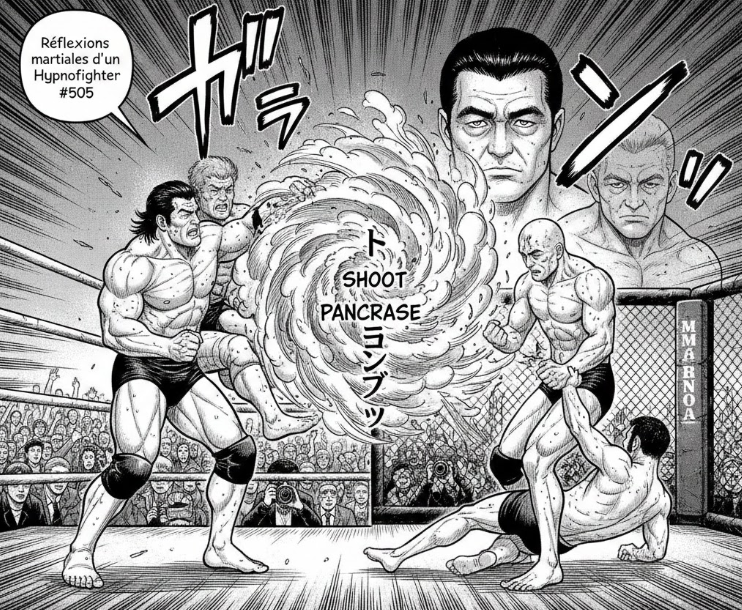
Réflexions martiales d’un Hypnofighter #505 : Du Catch Wrestling au Pro Wrestling et vers le MMA

Je trouve l’évolution du Catch Wrestling plutôt curieuse. Comme je l’ai partagé dans de précédentes chroniques, pour des raisons financières, à l’instar de la boxe à la même période et partout dans le monde, les lutteurs et « catch wrestlers », mais aussi les Judokas (Kimura) ou Karatékas (Oyama) sont passés par le Pro Wrestling (ce que nous appelons aujourd’hui catch WWE, AEW…).

Si aujourd’hui la grande majorité des catcheurs américains (WWE) sont inaptes au MMA, la situation est différente au Japon. Étrangement, le passage de figures comme Karl Gotch ou Billy Robinson a transformé ce qui n’était qu’un spectacle en une version plus « réaliste » du Pro Wrestling. Mais surtout, trois des plus grandes organisations de MMA des années 2000 au Japon sont nées de catcheurs.

Le ShootWrestling, qui est devenu ShootFighting et Shooto, a été créé par Sayama dès 1988. Il a mis en place un système de compétition de combat libre similaire à ce que nous avons connu sous les règles du Pancrace en France, puis a fondé une organisation professionnelle. En parlant de Pancrace, Funaki et Suzuki, également catcheurs, ont mis en place l’Hybrid Wrestling Pancrase que nous connaissons, avec au départ des matchs déterminés puis, par la suite, une compétition sportive classique. Enfin, Maeda a créé le RINGS, qui a permis à des combattants européens et russes de faire leurs armes.

L’esprit belliqueux du Catch Wrestling a ainsi transcendé la facette spectacle pour redonner naissance à des shows de MMA où le réalisme et l’efficacité primaient. Je pense que ces « Catch Wrestlers », Gotch et Robinson, ont trouvé un écho au Japon pour une philosophie développée à Wigan, au Royaume-Uni, et ce, malgré une culture totalement opposée à la leur.

Prenez ce qui est bon et juste pour vous. Be One, Pank. https://www.passioncombat.net/

Martial Reflections of an Hypnofighter #505: From Catch Wrestling to Pro Wrestling and Towards MMA

I find the evolution of Catch Wrestling rather peculiar. As I shared in previous columns, for financial reasons, much like boxing during the same period and all over the world, wrestlers and catch wrestlers, but also Judokas (Kimura) or Karatekas (Oyama) transitioned through Pro Wrestling (what we now call WWE, AEW catch…).

While today the vast majority of American wrestlers (WWE) are unfit for MMA, the situation is different in Japan. Strangely, the involvement of figures like Karl Gotch or Billy Robinson transformed what was merely a spectacle into a more « realistic » version of Pro Wrestling. More importantly, three of the biggest MMA organizations of the 2000s in Japan were born from wrestlers.

ShootWrestling, which became ShootFighting and Shooto, was created by Sayama as early as 1988. He established a system of free combat competition similar to what we knew as Pancrase rules in France, then founded a professional organization. Speaking of Pancrase, Funaki and Suzuki, also wrestlers, established the Hybrid Wrestling Pancrase that we know, initially with predetermined matches and later evolving into a classic sports competition. Finally, Maeda created RINGS, which allowed European and Russian fighters to gain experience.

The pugnacious spirit of Catch Wrestling thus transcended the spectacle aspect to revive MMA shows where realism and effectiveness prevailed. I believe that these Catch Wrestlers, Gotch and Robinson, found resonance in Japan for a philosophy developed in Wigan, UK, despite a culture totally opposite to their own.

Take what is good and right for you. Be One, Pank.

Réflexions martiales d’un Hypnofighter #494 : Pourquoi des catcheurs au Pride et au Rizin ?

Vous le savez, le MMA au Japon est assez différent de ce que nous connaissons aux USA ou en Europe. Ils ont une culture des shows associés au Pro Wrestling. Si les compétitions de K1 et même de Kyokushin arrivaient à remplir des stades, c’est souvent grâce à l’influence que le Puroresu a eue sur la culture nippone.

Les trois grands styles de MMA qui se sont diffusés — le Pancrase, le Shooto et la Rings — ont été créés par des Pro Wrestlers comme Funaki, Sayama et Maeda. C’est pour cette raison qu’au départ, les combats étaient parfois truqués. L’idée de ces « showmen » était de rendre le spectacle de plus en plus réaliste avec des formes dites « shoot », utilisant des techniques portées pleinement, surtout sur les frappes au corps.

Mais pourquoi cette recherche de réalisme alors que la WWE nous a rarement sorti des combattants aptes pour l’UFC, mis à part Lesnar et Batista dans une moindre mesure ? Grâce à l’influence du Catch britannique de Karl Gotch et de Billy Robinson. Comme je vous le partageais dans ma dernière réflexion, ils ont dû passer d’une lutte à soumission amateur à une forme professionnelle : le Pro Wrestling.

Mais comme les combattants étaient avant tout de vrais pratiquants qui cherchaient à projeter et soumettre, la transition vers le show a été difficile, et surtout douloureuse pour les seuls showmen issus de la musculation. L’apport du Catch Wrestling de Wigan a poussé les Pro Wrestlers japonais à s’entraîner partiellement à ce style fort et réaliste.

Donner plus de réalisme aux combats posait la question de savoir s’ils étaient aussi capables d’être compétents sans la facette « show ». D’où les Minowaman (Minawa), Sakuraba ou Takada. Tous issus de dojos de Pro Wrestling coachés par les Britanniques qui les entraînaient en mode réaliste.

Je reviendrai dessus, mais un Saku est élève de Robinson qui avait sa spécialité en Catch-As-Catch-Can sur le « double wristlock »… la Kimura…

Prenez ce qui est bon et juste pour vous. Be One, Pank. https://www.passioncombat.net/

Martial Reflections of an Hypnofighter #494: Why Pro Wrestlers in Pride and Rizin?

As you know, MMA in Japan is quite different from what we know in the US or Europe. They have a culture of shows associated with Pro Wrestling. If K1 and even Kyokushin competitions managed to fill stadiums, it is often thanks to the influence that Puroresu had on Japanese culture.

The three great styles of MMA that spread — Pancrase, Shooto, and Rings — were created by Pro Wrestlers like Funaki, Sayama, and Maeda. This is why, initially, the fights were sometimes fixed (worked). The idea of these « showmen » was to make the spectacle increasingly realistic with so-called « shoot » forms, using techniques executed fully, especially body strikes.

But why this search for realism when the WWE has rarely produced fighters suitable for the UFC, apart from Lesnar and Batista to a lesser extent? Thanks to the influence of British Catch Wrestling from Karl Gotch and Billy Robinson. As I shared with you in my last reflection, they had to transition from amateur submission wrestling to a professional form: Pro Wrestling.

But since the fighters were first and foremost true practitioners seeking to throw and submit, the transition to « show » was difficult, and above all painful for showmen who only came from bodybuilding backgrounds. The contribution of Wigan’s Catch Wrestling pushed Japanese Pro Wrestlers to partially train in this strong and realistic style.

Giving more realism to the fights raised the question of whether they were also capable of being competent without the « show » facet. Hence the likes of Minowaman, Sakuraba, or Takada. All came from Pro Wrestling dojos coached by the British who trained them in a realistic mode.

I will return to this, but « Saku » (Sakuraba) is a student of Robinson, whose specialty in Catch-As-Catch-Can was the « double wristlock »… the Kimura…

ake what is good and right for you. Be One, Pank. https://www.passioncombat.net/