
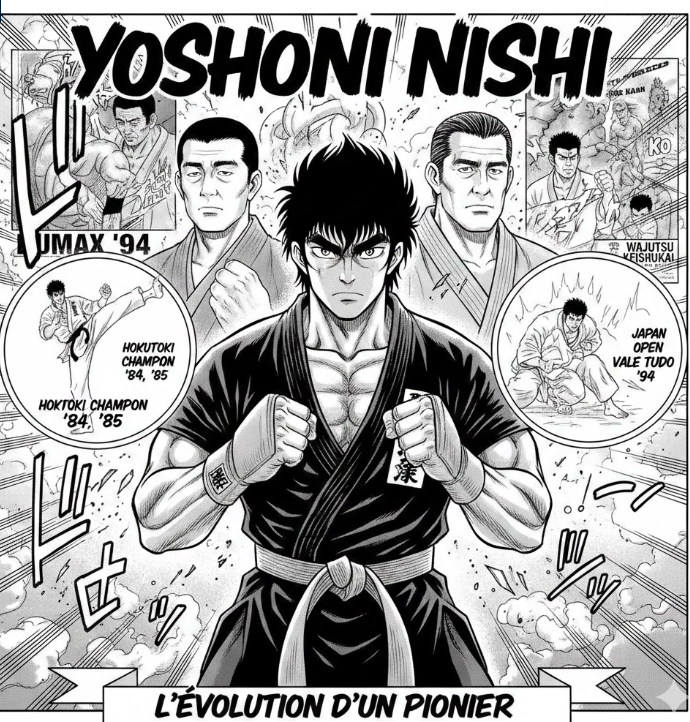
Réflexions Martiales d’un Hypnofighter #518 : Yoshinori Nishi

Vous ne vous souvenez probablement pas de ce combattant, d’autant plus si vous n’êtes pas un passionné de combat libre. En me penchant un peu sur le Daido Juku, ce karaté de Shihan Azuma qui est devenu le Kudo, je suis revenu sur les premiers pratiquants et champions. Nishi était l’un des grands de ce style, remportant en 1984 et 1985 le championnat Hokutoki.

Je reviendrai sur des éléments importants du Daido Juku, issu du Kyokushin, dans d’autres articles. Nishi a été formé au Judo par Kimura (la légende du Judo), puis rapidement au Kyokushinkai et surtout au Daido Juku vers 1983. Ce qui m’intéresse chez ce combattant, c’est qu’il a tenté de combattre dans des disciplines diverses. Il a notamment remporté le LUMAX, qui était déjà une sorte de MMA en tournoi, un peu comme l’UFC, en 1994. Quelques années auparavant, il avait combattu Rob Kaman (1990) en Kickboxing, où il subira un KO.

Il a été connu pour avoir affronté Rickson Gracie au premier Japan Open Vale Tudo de 1994. Il a rapidement perdu le match sans avoir pu s’exprimer. Ce qui est intéressant, c’est que la même année, nous avions un autre combattant du Daido Juku, d’ailleurs le premier Japonais à l’UFC, qui a perdu contre Royce Gracie : Minoki Ichihara.

Si Azuma a cherché en réponse à intégrer plus de sol et même à faire évoluer son Daido Juku, Nishi est parti dans une quête au travers de sa très célèbre école Wajutsu Keishukai. Il y a quelques années, j’avais lu qu’il avait été « coupé sous le pied » par les Gracie, parce qu’il s’était mis en tête de redévelopper le Jiujitsu au Japon. La réalité est plus simple : élève de Kimura, il a profité de sa rencontre avec un Gracie pour aller au Brésil faire une « recherche » sur la forme de Jiujitsu d’Helio Gracie, et savoir si la forme qu’ils avaient apprise était celle de la forme « originelle » du jiujitsu.

Chose que nous savons n’être pas le cas, car les Gracie ont été formés par Donato Pires, de la lignée Maeda, qui pratiquait un Kodokan Jiujitsu (les prémices du Judo). Nishi a orienté sa forme de combat vers le MMA, mettant de côté son Karategi et formant des combattants réputés dans les années 2000.

Il a vécu une période cruciale des arts martiaux modernes et, comme Azuma ou Sayama avec le Shooto, il y a eu une décision de se tourner vers l’efficacité et la mise à jour du combat plutôt que de rester dans la « tradition ».

Prenez ce qui est bon et juste pour vous. Be One, Pank.  https://www.passioncombat.net/

Martial Reflections of a Hypnofighter #518: Yoshinori Nishi

You probably don’t remember this fighter, especially if you’re not a free combat enthusiast. Going back a bit into Daido Juku, Shihan Azuma’s Karate which became Kudo, I revisited the early practitioners and champions. Nishi was one of the greats of this style, winning the Hokutoki championship in 1984 and 1985.

I will come back to important elements of Daido Juku, stemming from Kyokushin, in other articles. Nishi was trained in Judo by Kimura (the Judo legend), then quickly in Kyokushinkai and especially Daido Juku around 1983. What interests me about this fighter is that he tried to compete in various disciplines. He notably won the LUMAX, which was already a kind of MMA tournament, a bit like the UFC, in 1994. A few years before, he had fought Rob Kaman (1990) in Kickboxing, where he suffered a KO.

He was known for facing Rickson Gracie at the first Japan Open Vale Tudo in 1994. He quickly lost the match without being able to express himself. What’s interesting is that the same year, we had another Daido Juku fighter, actually the first Japanese in the UFC, who lost against Royce Gracie: Minoki Ichihara.

While Azuma sought to integrate more ground fighting and even evolve his Daido Juku in response, Nishi embarked on a quest through his very famous Wajutsu Keishukai school. A few years ago, I had read that he had been « undermined » by the Gracies because he had set out to redevelop Jiujitsu in Japan. The reality is simpler: a student of Kimura, he took advantage of his meeting with a Gracie to go to Brazil to do « research » on Helio Gracie’s form of Jiujitsu, and to know if the form they had learned was the « original » form of jiujitsu.

Something we know is not the case, as the Gracies were trained by Donato Pires, from the Maeda lineage, who practiced Kodokan Jiujitsu (the beginnings of Judo). Nishi oriented his fighting style towards MMA, setting aside his Karategi and training renowned fighters in the 2000s.

He lived through a crucial period of modern martial arts and, like Azuma or Sayama with Shooto, there was a decision to turn towards efficiency and updating combat rather than staying in « tradition ».

Take what is good and right for you. Be One, Pank.  https://www.passioncombat.net/
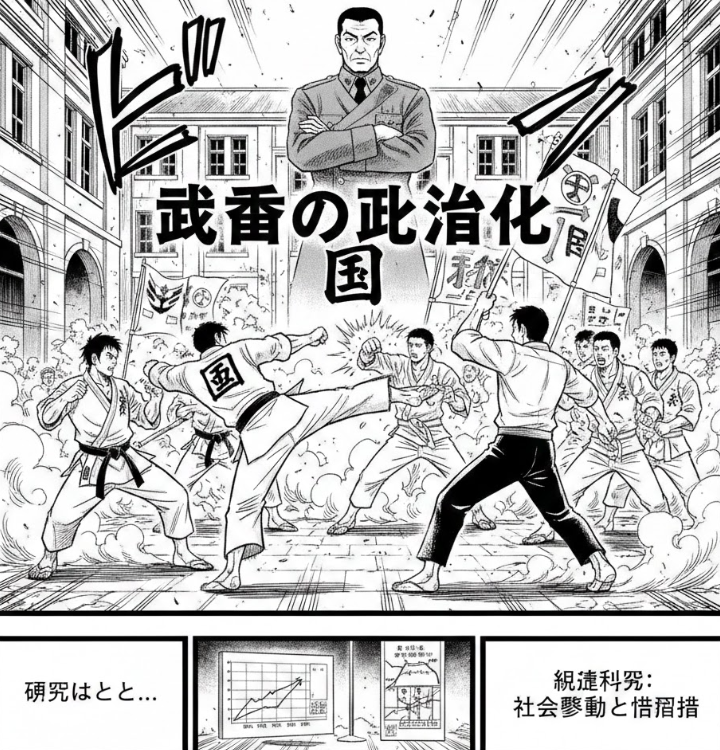
Réflexions martiales d’un Hypnofighter #513 : Les arts martiaux politisés

Les rixes et combats violents, voire mortels, font partie de l’histoire des arts martiaux. Nous pouvons facilement oublier que les boxes ou les luttes, sans même parler des armes, ont pour objectifs le combat, la domination physique et psychologique sur les opposants.

Quand on lit ce qui se passe régulièrement, avec des conséquences comme la mort de groupes politiques des deux côtés de l’échiquier, c’est malheureusement ce à quoi le combat peut mener.

Et les arts martiaux sont souvent associés à des idées nationalistes. On l’oublie parfois avec la mondialisation des systèmes et des cultures, mais pour reprendre le Japon pour exemple, le Shorinji Kempo de So Doshin a réussi sa diffusion initiale avec deux éléments clefs. Aider les jeunes hommes de la nation nippone (qui était, pour rappel, membre de l’Axe) à être plus solides et pouvoir aider la nation et également, dans un deuxième temps, à partir des années 50-60, s’inscrire dans le monde scolaire et universitaire.

Les membres du Shorinji étudiants se trouvaient dans toutes les universités et étaient au service de mouvements nationalistes. Pendant les années 68, ils utilisaient leurs connaissances pour cogner les franges plus à gauche des étudiants (cf. la guerre avec le Kyokushin dont je vous parlais).

Si un dojo cherche une neutralité, avec un uniforme et une conformité, il est aussi important de connaître l’intention des fondateurs (qui peuvent évoluer) et aussi prendre conscience que ce qui est enseigné pourra être utilisé avec des intentions idéologiques et politiques pour agresser ceux qui ne pensent pas pareil ou pour obtenir des biens divers.

Les sports de combat ne sont pas une discipline neutre et entraînent dans le quotidien des conséquences possibles. Oui, il n’y a pas besoin d’arts martiaux pour se battre, mais beaucoup de groupes politisés se forment désormais en MMA, en plus du matériel qu’ils vont avoir lors de « meetings ».

Prenez ce qui est bon et juste pour vous. Be One, Pank. https://www.passioncombat.net/
Martial Reflections of a Hypnofighter #513: Politicized Martial Arts

Brawls and violent, even deadly, fights are part of the history of martial arts. We can easily forget that boxing or wrestling, not to mention weapons, have the objectives of combat, physical and psychological domination over opponents.

When we read what regularly happens, with consequences such as the death of political groups on both sides of the spectrum, this is unfortunately what combat can lead to.

And martial arts are often associated with nationalist ideas. We sometimes forget this with the globalization of systems and cultures, but to take Japan as an example, So Doshin’s Shorinji Kempo achieved its initial spread with two key elements. Helping young Japanese men (who, let’s remember, were members of the Axis) to be stronger and able to help the nation and also, in a second phase from the 1950s-60s, integrating into the school and university world.

Student members of Shorinji were found in all universities and served nationalist movements. During the 1968 years, they used their knowledge to beat up the more left-leaning fringes of students (cf. the war with Kyokushin I mentioned).

If a dojo seeks neutrality, with a uniform and conformity, it is also important to know the founders’ intentions (which can evolve) and also to realize that what is taught can be used with ideological and political intentions to attack those who do not think similarly or to obtain various goods.

Combat sports are not a neutral discipline and lead to possible daily consequences. Yes, there is no need for martial arts to fight, but many politicized groups are now forming in MMA, in addition to the equipment they will have during « meetings. »

Take what is good and right for you. Be One, Pank. https://www.passioncombat.net/

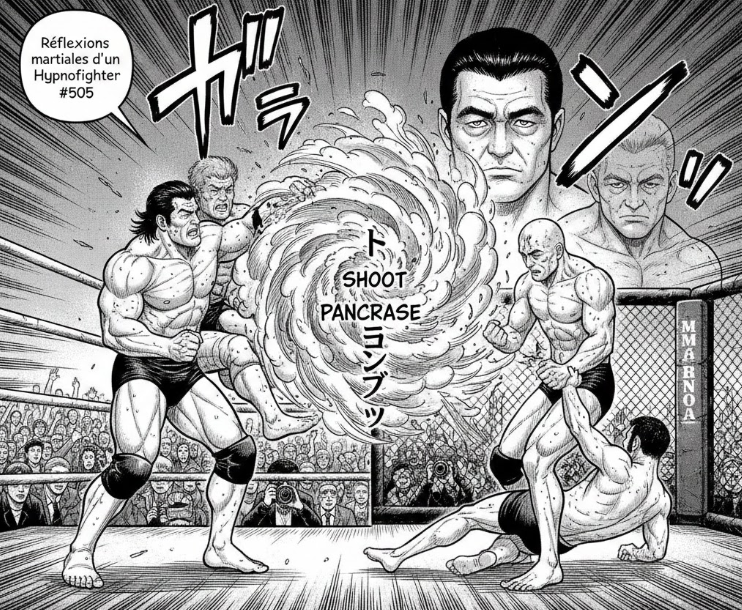
Réflexions martiales d’un Hypnofighter #505 : Du Catch Wrestling au Pro Wrestling et vers le MMA

Je trouve l’évolution du Catch Wrestling plutôt curieuse. Comme je l’ai partagé dans de précédentes chroniques, pour des raisons financières, à l’instar de la boxe à la même période et partout dans le monde, les lutteurs et « catch wrestlers », mais aussi les Judokas (Kimura) ou Karatékas (Oyama) sont passés par le Pro Wrestling (ce que nous appelons aujourd’hui catch WWE, AEW…).

Si aujourd’hui la grande majorité des catcheurs américains (WWE) sont inaptes au MMA, la situation est différente au Japon. Étrangement, le passage de figures comme Karl Gotch ou Billy Robinson a transformé ce qui n’était qu’un spectacle en une version plus « réaliste » du Pro Wrestling. Mais surtout, trois des plus grandes organisations de MMA des années 2000 au Japon sont nées de catcheurs.

Le ShootWrestling, qui est devenu ShootFighting et Shooto, a été créé par Sayama dès 1988. Il a mis en place un système de compétition de combat libre similaire à ce que nous avons connu sous les règles du Pancrace en France, puis a fondé une organisation professionnelle. En parlant de Pancrace, Funaki et Suzuki, également catcheurs, ont mis en place l’Hybrid Wrestling Pancrase que nous connaissons, avec au départ des matchs déterminés puis, par la suite, une compétition sportive classique. Enfin, Maeda a créé le RINGS, qui a permis à des combattants européens et russes de faire leurs armes.

L’esprit belliqueux du Catch Wrestling a ainsi transcendé la facette spectacle pour redonner naissance à des shows de MMA où le réalisme et l’efficacité primaient. Je pense que ces « Catch Wrestlers », Gotch et Robinson, ont trouvé un écho au Japon pour une philosophie développée à Wigan, au Royaume-Uni, et ce, malgré une culture totalement opposée à la leur.

Prenez ce qui est bon et juste pour vous. Be One, Pank. https://www.passioncombat.net/

Martial Reflections of an Hypnofighter #505: From Catch Wrestling to Pro Wrestling and Towards MMA

I find the evolution of Catch Wrestling rather peculiar. As I shared in previous columns, for financial reasons, much like boxing during the same period and all over the world, wrestlers and catch wrestlers, but also Judokas (Kimura) or Karatekas (Oyama) transitioned through Pro Wrestling (what we now call WWE, AEW catch…).

While today the vast majority of American wrestlers (WWE) are unfit for MMA, the situation is different in Japan. Strangely, the involvement of figures like Karl Gotch or Billy Robinson transformed what was merely a spectacle into a more « realistic » version of Pro Wrestling. More importantly, three of the biggest MMA organizations of the 2000s in Japan were born from wrestlers.

ShootWrestling, which became ShootFighting and Shooto, was created by Sayama as early as 1988. He established a system of free combat competition similar to what we knew as Pancrase rules in France, then founded a professional organization. Speaking of Pancrase, Funaki and Suzuki, also wrestlers, established the Hybrid Wrestling Pancrase that we know, initially with predetermined matches and later evolving into a classic sports competition. Finally, Maeda created RINGS, which allowed European and Russian fighters to gain experience.

The pugnacious spirit of Catch Wrestling thus transcended the spectacle aspect to revive MMA shows where realism and effectiveness prevailed. I believe that these Catch Wrestlers, Gotch and Robinson, found resonance in Japan for a philosophy developed in Wigan, UK, despite a culture totally opposite to their own.

Take what is good and right for you. Be One, Pank.

Réflexions Martiales d’un Hypnofighter #311 : L’influence du spectacle au Japon

Cet article explore l'influence du catch professionnel sur le MMA au Japon, notamment à travers des organisations comme Pride, Pancrase et Shooto. Il compare la culture japonaise, qui valorise les prouesses techniques et physiques, avec celle de l’Occident, davantage centrée sur les KO et la percussion. Enfin, il examine comment le catch a surpassé le MMA en popularité grâce à une énergie et une intensité uniques.

Je trouve que l’UFC est souvent particulièrement ennuyeuse, avec cette volonté de transformer le MMA en un divertissement proche de la WWE. D’ailleurs, les deux entités ont désormais fusionné. Ce qui est intéressant, c’est qu’une dynamique similaire existe au Japon, également influencée par le catch ou pro wrestling.

Nous savons que le Pride a été initié par les catcheurs de la NJPW, avec en tête d’affiche le combat entre Rickson Gracie et Nobuhiko Takada. Ce combat n’avait aucun sens sportif, mais il a permis de mettre en avant le concept du combat libre. Pour beaucoup, Takada était considéré comme le meilleur combattant japonais, en grande partie grâce à l’influence du pro wrestling.

Les Japonais apprécient particulièrement ce type de compétitions, qui se divisent en plusieurs styles, notamment le strong style et le shoot style. Ce dernier est particulièrement intéressant, car les cultures Shooto, Pancrase et Rings sont issues de cet univers du spectacle avant de s’orienter vers un réalisme croissant.

C’est d’ailleurs pour cette raison que des doutes ont émergé concernant les premières années du Pancrase, où certains combats semblaient encore s’inscrire dans une logique de spectacle, avec des vainqueurs potentiellement prédéterminés. Cependant, nous sommes loin des scénarios très théâtraux du prowrestling américain. Pour les Japonais, l’objectif est d’acclamer les prouesses physiques et techniques.

Cela explique pourquoi le public japonais s’est éduqué à toutes les phases du MMA, du combat debout au sol. Ce niveau d’appréciation est parfois moins visible en Europe ou aux États-Unis, où le désir de voir des percussions et des KO reste dominant. Cela ne signifie pas que les Nippons n’apprécient pas les KO, mais un combat prolongé au sol ne provoquera pas de critiques.

Le pro wrestling a connu des difficultés avec l’émergence du MMA. Cependant, le MMA a ensuite décliné en popularité, probablement parce que la culture du catch reste plus intense et divertissante. Il suffit de comparer l’ambiance autour du Rizin et celle du Wrestle Kingdom : bien que le public soit souvent le même, l’énergie des deux événements est totalement différente. The show must go on.

Prenez ce qui est bon et juste pour vous.
Be One,
Pank
https://www.passioncombat.net

Martial Reflections of a Hypnofighter #311: The Influence of Spectacle in Japan

I find the UFC often quite boring, with its attempt to turn MMA into entertainment akin to WWE. In fact, the two entities have now merged. Interestingly, a similar dynamic exists in Japan, where MMA is also influenced by professional wrestling.

We know that Pride was initiated by NJPW wrestlers, featuring a main event between Rickson Gracie and Nobuhiko Takada. This fight made little sporting sense but helped promote the concept of free fighting. For many in Japan, Takada was considered the best possible fighter, largely due to the influence of pro wrestling.

Japanese audiences enjoy such competitions, which can be divided into several styles, including strong style and shoot style. The latter is particularly intriguing, as Shooto, Pancrase, and Rings cultures originated from this world of spectacle, gradually evolving toward greater realism.

This explains why there were questions surrounding Pancrase’s early years, where some matches seemed to retain the spirit of spectacle, possibly with predetermined winners. However, this is far from the heavily scripted nature of American prowrestling. For the Japanese, the goal is to celebrate physical and technical prowess.

As a result, Japanese audiences have educated themselves on all aspects of MMA, from stand-up to ground fighting. This level of appreciation is sometimes less evident in Europe or the U.S., where the focus remains on striking and knockouts. That said, the Japanese do enjoy KOs, but a prolonged ground round won’t draw criticism.

Pro wrestling faced challenges with the rise of MMA, but MMA later declined in popularity, likely because the wrestling culture is more intense and entertaining. A simple comparison between the atmosphere at Rizin and Wrestle Kingdom highlights this: even if the audience overlaps, the energy is completely different. The show must go on.

Take what is good and right for you.
Be One,
Pank
https://www.passioncombat.net