
Réflexions martiales d’un Hypnofighter #510 : Waldemar Santana vs. Hélio Gracie

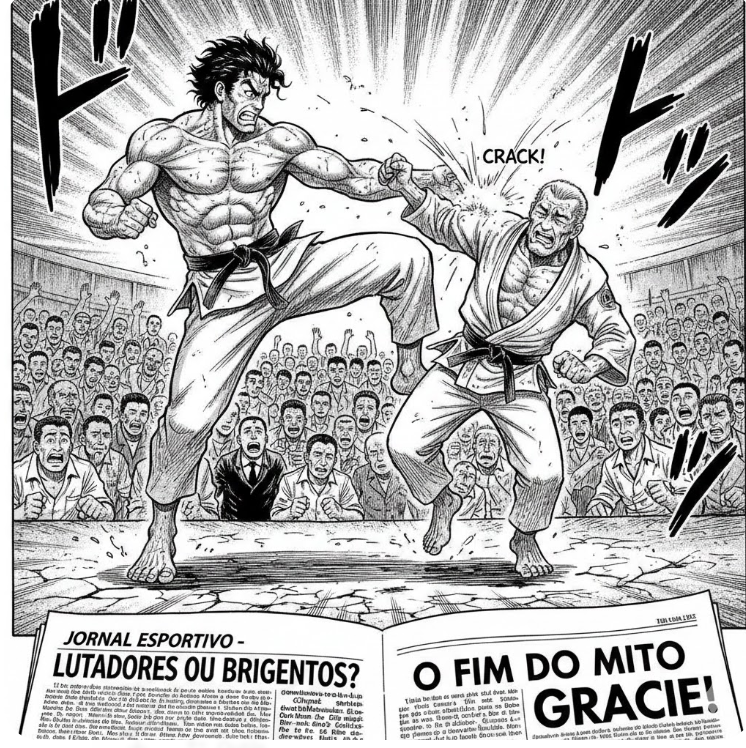
Je suis sûr que vous avez déjà entendu parler de Waldemar si vous vous intéressez à l’héritage Gracie. Waldemar était un élève des frères Gracie et plutôt bon ; il a aidé Carlson à préparer ses combats. Il a commencé à représenter l’académie Gracie pour divers combats, mais il semble qu’un doute soit apparu concernant un organisateur qui truquait les matchs (courant dans les sports de combat, les combats réels ne stimulent pas l’intérêt, cf. le catch professionnel).

Cependant, Santana est assez pauvre et cela ne le dérange pas tant qu’il gagne de l’argent. Après avoir été renvoyé par les Gracie, il défia Hélio qui ne cessait de dire qu’il était mauvais. Après une décision concernant les conditions de combat – en Gi, sous la forme du vale tudo et sans limite de temps – Hélio fut balayé par Waldemar dans un match qui dura plus de 3 heures.

Les combats longs étaient fréquents à l’époque au Brésil, mais il ne s’y passait pas grand-chose. Santana était dans la garde d’Hélio qu’il ne parvenait pas à passer, mais il ne cessait de lui asséner des coups de tête au corps et au visage. Le match se termina après s’être relevé et un gros coup de pied au visage d’Hélio.

Santana a mis à mal le discours Gracie, et Hélio a été beaucoup critiqué par George et la famille en général. Son orgueil de combattant de 42 ans a fait passer le Jiu-Jitsu pour un système où le plus fort pouvait vaincre, alors qu’il était officiellement peu technique. Et cette fois, il n’avait pas l’excuse de ne pas combattre en kimono. Pour les journalistes, les deux protagonistes n’étaient pas des combattants, mais des bagarreurs.

Santana fut un grand combattant des années cinquante. Il a ensuite combattu Carlson et d’autres bons combattants, mais il a été mis de côté par l’influence et la politique Gracie.

Prenez ce qui est bon et juste pour vous. Be One, Pank.

Martial Reflections of a Hypnofighter #510: Waldemar Santana vs. Hélio Gracie

I’m sure you’ve heard of Waldemar if you’re interested in the « Gracie Legacy. » Waldemar was a student of the Gracie brothers and quite good; he helped Carlson prepare for his fights. He began representing the Gracie academy for various fights, but it seems that doubts arose about an organizer who was fixing matches (common in combat sports; real fights don’t always stimulate interest, cf. professional wrestling).

However, Santana was quite poor and didn’t mind as long as he earned money. After being fired by the Gracies, he challenged Hélio, who constantly claimed he was no good. After a decision on the fight conditions – in Gi, in a vale tudo format, and with no time limit – Hélio was swept aside by Waldemar in a match that lasted over 3 hours.

Long fights were common in Brazil at the time, but not much happened. Santana was in Hélio’s guard, which he couldn’t pass, but he repeatedly delivered headbutts to the body and face. The match ended after they stood up and Hélio received a big kick to the face.

Santana undermined the Gracie narrative, and Hélio was heavily criticized by George and the family in general. His pride as a 42-year-old fighter made Jiu-Jitsu appear as a system where the stronger person could win, even though it was officially not very technical. And this time, he didn’t have the excuse of not fighting in a kimono. For journalists, the two protagonists were not fighters but brawlers.

Santana was a great fighter in the 1950s. He later fought Carlson and other good fighters, but he was sidelined by Gracie influence and politics.

Take what is good and right for you. Be One, Pank.
Réflexions martiales d’un Hypnofighter #497 : La rétention de garde en Jiu-Jitsu

Comme beaucoup de combattants de MMA, quand j’ai commencé à combattre après la découverte du Jiu-Jitsu, je voulais me retrouver dos au sol pour placer un triangle ou un jujigatame (clé de bras). De plus, en France, au début de la pratique, les percussions au visage au sol étaient très rarement autorisées.

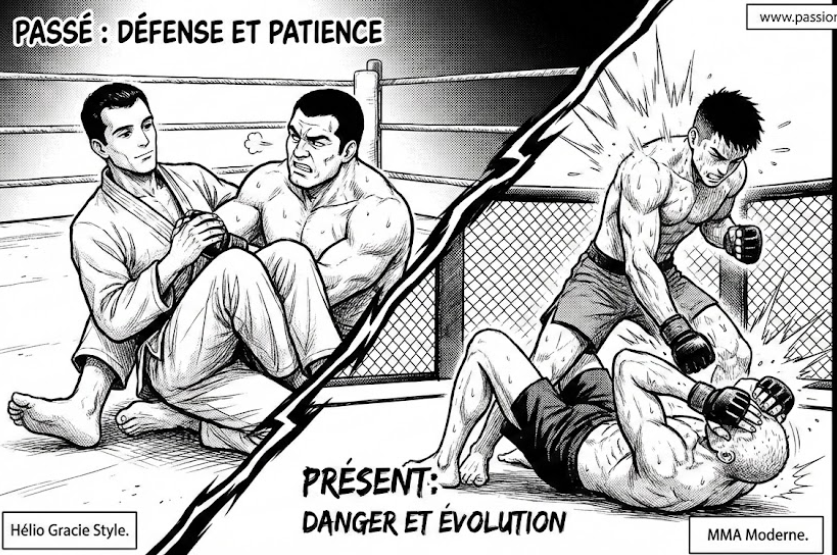
Comme pour beaucoup de pratiquants, le combat depuis la garde (sur le dos) était pour moi l’élément différenciateur du Jiu-Jitsu. Avec les années, ma réflexion autour du combat de rue, et plus encore avec l’évolution du MMA, a changé : l’idée d’être sur le dos n’était plus du tout ce que je souhaitais. Je savais même qu’avec certains types de combattants, cela pourrait s’avérer très complexe.

Pourtant, en compétition IBJJF/CFJJB, s’il ne se passe pas grand-chose, c’est souvent le combattant qui est dessous (c’est-à-dire en garde) qui obtiendra la décision arbitrale. Je me demandais pourquoi. Dans les différents textes que je lis sur le BJJ, la Luta Livre et le Catch Wrestling, il y a peut-être une réponse.

Rappelez-vous que les combats jusqu’aux années 70 ressemblaient au Judo et pouvaient même accepter le principe du tombé de la lutte (pin). Les frères Gracie, et surtout Hélio, suivaient la doctrine de self-défense de Carlos, son aîné. C’est notamment parce qu’il n’était pas bon en Tachi Waza (debout en mode projection). Du coup, il tirait la garde et la fermait, sachant que les combats pouvaient souvent durer plusieurs rounds de 10 minutes (sur ring).

Il n’y avait pas de frappes ; les combats de Vale Tudo jusqu’aux années 50-60 étaient assez rares. Par conséquent, il fatiguait les adversaires qui étaient souvent des spécialistes de projection et de contrôle. Les combats finissaient majoritairement en match nul (draw) ou par des soumissions de la part d’Hélio.

Il est possible que Carlos Jr, avec les règles du Jiu-Jitsu sportif, ait voulu mettre en valeur ce qui fait la vraie différence du Jiu-Jitsu par rapport aux autres styles de préhension, en favorisant les combattants qui tirent la garde. Rappelez-vous que la première génération de pratiquants de Jiu-Jitsu Gracie n’était pas bonne du tout debout ; d’où, comme en Kosen Judo, le développement du sol.

Prenez ce qui est bon et juste pour vous. Be One, Pank. https://www.passioncombat.net/

 Martial Reflections of an Hypnofighter #497: Guard Retention in Jiu-Jitsu

Like many MMA fighters, when I started fighting after discovering Jiu-Jitsu, I wanted to end up on my back on the ground to set up a triangle choke or a jujigatame (armbar). Furthermore, in France, in the early days of the practice, strikes to the face on the ground were very rarely allowed.

For me, like many practitioners, fighting from the guard (on one’s back) was the differentiating element of Jiu-Jitsu. Over the years, my reflections on street fighting, and even more so with the evolution of MMA, changed: the idea of being on my back was no longer what I wanted at all. I even knew that against certain types of fighters, it could prove very complex.

However, in IBJJF/CFJJB competition, if not much is happening, it is often the fighter underneath (i.e., in guard) who will get the referee’s decision. I wondered why. In the various texts I read on BJJ, Luta Livre, and Catch Wrestling, there might be an answer.

Remember that fights up until the 70s resembled Judo and could even accept the wrestling principle of the pin. The Gracie brothers, and especially Helio, followed the self-defense doctrine of Carlos, his elder brother. This was notably because he was not good at Tachi Waza (standing throws). Therefore, he pulled guard and closed it, knowing that fights could often last for several 10-minute rounds (in a ring).

There were no strikes; Vale Tudo fights until the 50s and 60s were quite rare. Consequently, he tired out opponents who were often specialists in throws and control. The fights mostly ended in a draw or with submissions by Helio.

It is possible that Carlos Jr., with sporting Jiu-Jitsu rules, wanted to highlight what makes the true difference of Jiu-Jitsu compared to other grappling styles by favoring fighters who pull guard. Recall that the first generation of Gracie Jiu-Jitsu practitioners was not good at all standing up; hence, just like in Kosen Judo, the development of ground fighting.

Take what is good and right for you. Be One, Pank. https://www.passioncombat.net/
Réflexions martiales d’un Hypnofighter #496 : Le cas Jorge (George) Gracie

Plus je lis sur l’histoire du Gracie Jiu-jitsu, et bien qu’ils aient partagé une forme de jiu-jitsu ayant remis en cause les logiques de combat et que la pratique quotidienne reste ludique tout en étant efficace, je me rends compte à quel point ce sont des escrocs. Ce sont de sales types, sans même parler de l’esprit de culte (autour de Carlos) ou des positions idéologiques questionnables (l’eugénisme).

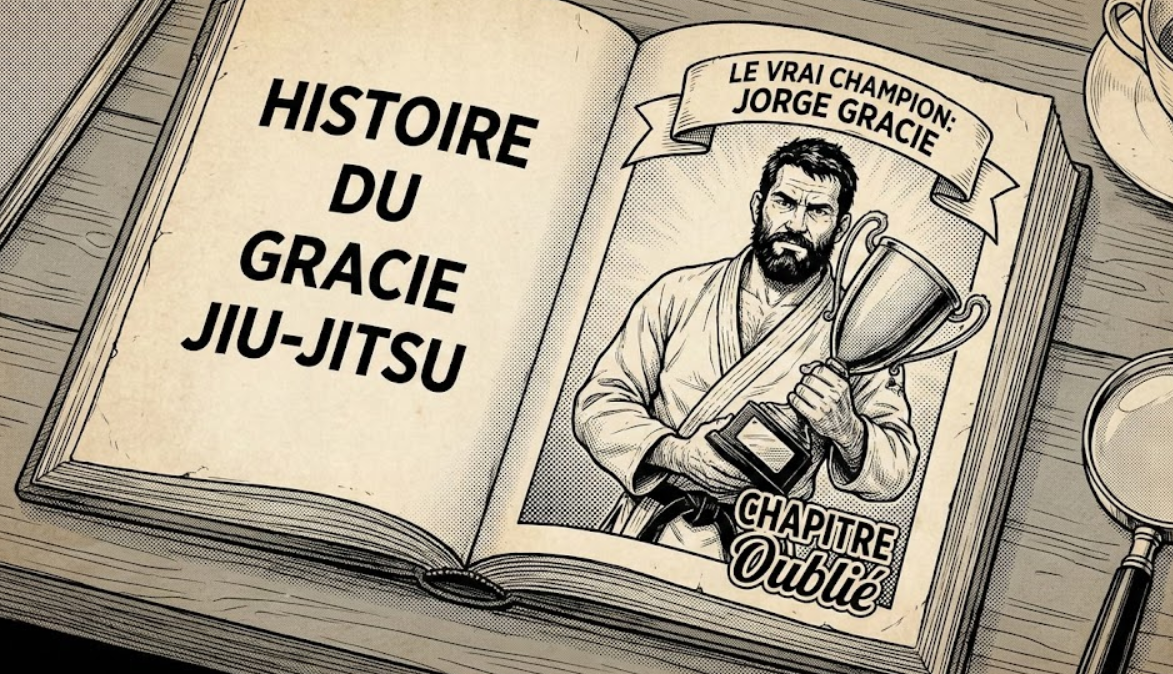
Carlos et Hélio, comme tout « fondateur » d’école, ont remanié l’histoire en diminuant ou en effaçant certains de leurs frères de l’équation. Gastão, qui n’a pas été un combattant, est rarement mentionné. C’est aussi le cas d’Oswaldo, qui a pourtant plus combattu que Carlos, et surtout de Jorge (George).

Vous avez sûrement en tête le fait qu’Hélio était malingre et qu’il a révolutionné le Jiu-jitsu pour s’adapter à son faible poids ? C’est faux. Dans les articles de journaux et lors des pesées de combat, Hélio pesait à 17 ans entre 62 et 63 kg, et a fait des combats pas loin de 70 kg. Gardez en tête que les Brésiliens étaient assez « petits » en taille et en poids à l’époque.

Mais Jorge, lui, faisait quasiment le même poids et a combattu des dizaines de fois dans tous les défis, ce qui n’était absolument pas le cas pour Hélio. Jorge a combattu en Jiu-jitsu, sous les formes de Judo de l’époque, en Catch Wrestling, et même en Gréco-romaine et en Vale Tudo, pour finir avec le Pro Wrestling.

Il prenait des adversaires de 40 kg de plus que lui. Il gagnait, il perdait, mais il était ultra-agressif contre tous les combattants. Sa grande différence avec Hélio, et ce qui fait qu’il pouvait perdre plutôt que d’aller au match nul (une recherche classique dans les combats de l’époque), c’est qu’il voulait soumettre coûte que coûte, alors que son cadet faisait de la rétention et cherchait les opportunités de contre.

Jorge a assez vite partagé avec la Luta Livre et la Capoeira, mis en place son Académie et combattu pour lui-même. Il a diffusé sur une grande partie du territoire le Jiu-jitsu Gracie, mais il était certainement trop belliqueux pour rester sous la coupe de Carlos. C’est un pratiquant qui a pourtant eu des élèves, mais qui a été étouffé dans le storytelling familial.

Prenez ce qui est bon et juste pour vous. Be One, Pank. https://www.passioncombat.net/

Title: Martial Reflections of a Hypnofighter #496: The Case of Jorge (George) Gracie

The more I read about the history of Gracie Jiu-Jitsu, and despite the fact that they shared a form of jiu-jitsu that challenged combat logic and that daily practice remains fun while being effective, I realize to what extent they are crooks. They are nasty guys, not to mention the cult-like mentality (around Carlos) or questionable ideological positions (eugenics).

Carlos and Helio, like any school « founders, » reshaped history by diminishing or erasing some of their brothers from the equation. Gastão, who was not a fighter, is rarely mentioned. This is also true for Oswaldo, who nevertheless fought more than Carlos, and especially for Jorge (George).

You probably have in mind the idea that Helio was frail and revolutionized Jiu-Jitsu to adapt to his light weight? False. In newspaper articles and fight weigh-ins, Helio weighed between 62 and 63kg at age 17, and had fights close to 70kg. Keep in mind that Brazilians were generally quite « small » in height and weight at the time.

But Jorge weighed almost the same and fought dozens of times in every challenge, which was absolutely not the case for Helio. Jorge fought in Jiu-Jitsu, in the Judo forms of the era, in Catch Wrestling, even in Greco-Roman and Vale Tudo, ending up in Pro Wrestling.

He took on opponents 40kg heavier than him. He won, he lost, but he was ultra-aggressive against all fighters. His great difference with Helio, and what meant he might lose rather than fight to a DRAW (a classic goal in fights of that era), is that he wanted to submit at all costs, whereas his younger brother used stalling tactics and looked for counter-opportunities.

Jorge quite quickly shared knowledge with Luta Livre and Capoeira, set up his own Academy, and fought for himself. He spread Gracie Jiu-Jitsu over a large part of the territory, but was certainly too pugnacious to remain under Carlos’s thumb. He was a practitioner who did have students, yet was stifled by the family storytelling.

Take what is good and right for you. Be One, Pank. https://www.passioncombat.net/
Réflexions martiales d’un Hypnofighter #490 : Géo Omori

Nous avons tous « acheté » l’histoire orientée par Rorion Gracie, selon laquelle seuls les Gracie ont introduit le Jiu-Jitsu au Brésil en lien direct avec Maeda. Seulement, l’histoire ne ment pas, et encore moins les articles de l’époque que vous pouvez retrouver dans la série de livres CHOQUE. Carlos et George Gracie n’ont pas étudié directement avec le Conde Koma, mais avec le seul élève certifié par le sensei : Donato Pires dos Reis.

Carlos a été un spécialiste du marketing, comme l’a été toute la famille Gracie, et d’un certain côté, merci à eux, car nous avons une chouette discipline avec laquelle nous pouvons jouer quotidiennement. Je reviendrai sur tous ces mensonges et arrangements historiques dans différents articles et vidéos.

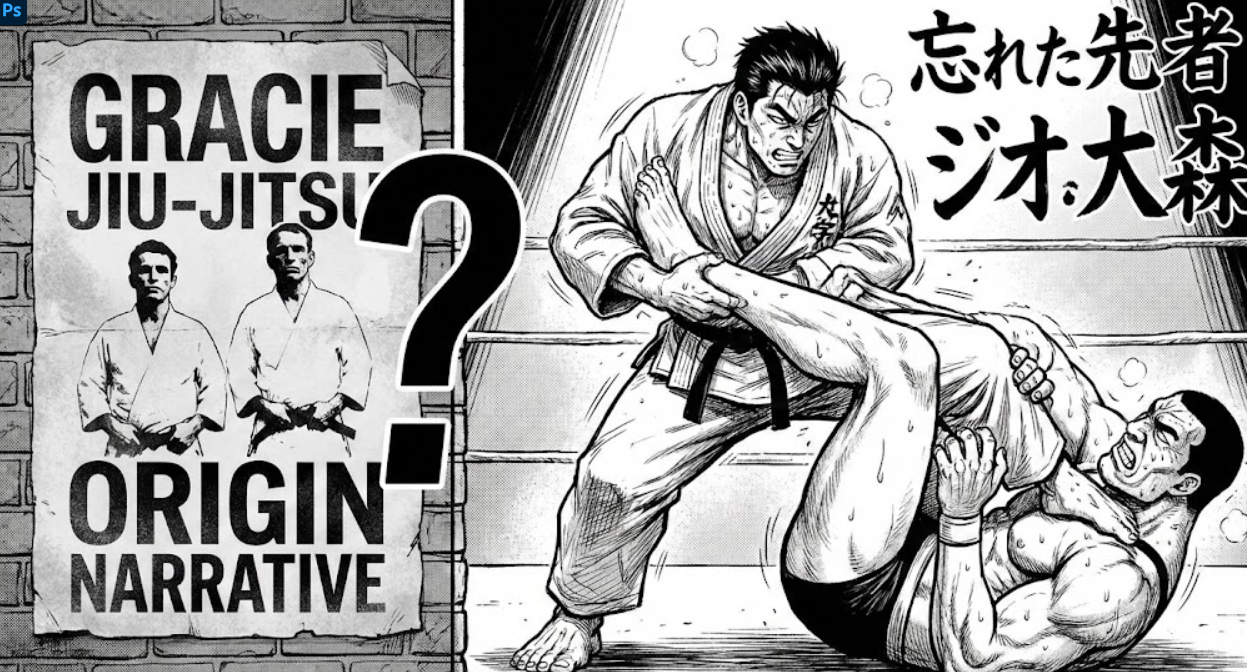
Dans cet effacement historique, il y a Géo Omori. Il a été un combattant qui a bien plus combattu que Carlos, Georges ou Hélio. C’était un Japonais qui fut le premier à développer le Jiu-Jitsu à São Paulo et à combattre très régulièrement. On a tendance à croire que les combats au Brésil étaient tous des « Vale Tudo », ce qui n’était absolument pas le cas jusqu’en 1935. Les athlètes combattaient soit sous des règles de Lutte Gréco-Romaine, de Lutte Libre, parfois de Catch Wrestling, un peu de Judo (le style qu’on nomme Jiu-Jitsu), ou sous des règles mixtes mêlant ces différentes disciplines.

Chose intéressante, il gagna beaucoup de combats grâce à des clés de jambes, ce qui nous rappelle que le Kodokan Judo enseignait déjà entre 1907 et 1915 ce type de techniques (qui aujourd’hui sont un lointain souvenir pour nos amis judokas).

Il a été l’un des plus grands promoteurs du Jiu-Jitsu et osait prendre tous les combats, peu importent les règles. Malheureusement pour le monde du Jiu-Jitsu au Brésil, il est mort assez jeune, ce qui fait qu’il n’a pas pu continuer à faire reconnaître son style agressif. À noter que les Gracie, et surtout Hélio, étaient à l’inverse de George : des pratiquants de Jiu-Jitsu de défense et d’opportunité. La « rétention », ça vient d’Hélio.

L’histoire de cet homme est malheureusement oubliée malgré son palmarès et sa maîtrise du budo de Kano, pour servir le récit du Gracie Jiu-Jitsu.

Prenez ce qui est bon et juste pour vous. Be One, Pank. https://www.passioncombat.net/

 Martial Reflections of an Hypnofighter #490: Geo Omori

We all « bought » the slanted history presented by Rorion Gracie, where only the Gracies introduced Jiu-Jitsu to Brazil in a direct line with Maeda. However, history does not lie, and even less so the articles of the era that you can find in the CHOQUE book series. Carlos and George Gracie did not study directly with Conde Koma, but with the only student certified by the sensei: Donato Pires dos Reis.

Carlos was a marketing specialist, as was the entire Gracie family, and in a way, thank you to them, because we have a great discipline we can play with daily. I will return to all these lies and historical arrangements in various articles and videos.

Within this historical erasure exists Geo Omori. He was a fighter who fought far more than Carlos, George, or Helio. He was a Japanese man who was the first to develop Jiu-Jitsu in São Paulo and to fight very regularly. We tend to believe that fights in Brazil were all « Vale Tudo, » which was absolutely not the case until 1935. Athletes fought under Greco-Roman Wrestling rules, FreeStyle, sometimes Catch Wrestling, a bit of Judo (the style we call Jiu-Jitsu), or mixed rules combining these different disciplines.

Interestingly, he won many fights with leg locks, recalling that Kodokan Judo was already teaching these types of techniques between 1907 and 1915 (which today are a distant memory for our judoka friends).

He was one of the greatest promoters of Jiu-Jitsu and dared to take any fight under any rules. Unfortunately for the world of Jiu-Jitsu in Brazil, he died quite young, which meant he could not continue to gain recognition for his aggressive style. It should be noted that the Gracies, and especially Helio, were the opposite of George: they were defensive and opportunistic Jiu-Jitsukas. « Retention » comes from Helio.

The history of this man is unfortunately forgotten, despite his record and his mastery of Kano’s budo, to serve the Gracie Jiu-Jitsu narrative.

Take what is good and right for you. Be One, Pank. https://www.passioncombat.net/