Réflexions Martiales d’un Hypnofighter #520 : La Gravata

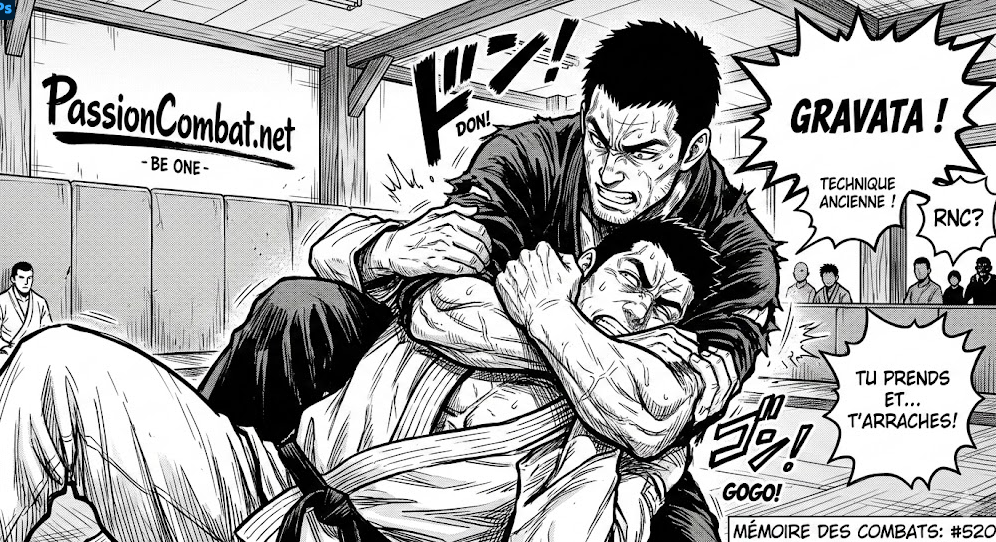
Hier, au dojo, on parlait des “guillotines” en Luta Livre et BJJ. J’expliquais qu’il y a encore quelques années, il n’y avait pas de terminologies comme Anaconda (nommé par Milton Viera) ou Brabo. La plupart du temps, c’était « la guillotine ». Ce sont les Américains qui ont commencé à donner des noms à toutes les techniques. 

D’ailleurs, le Brabo Choke s’appelle aussi la D’Arce. Cela a facilité la compréhension de quel type de guillotine (ou autres techniques) on enseigne et on demande en combat. La guillotine étant, de plus, un étranglement, un contrôle de tête ou une clé de cervicale : le fameux “tu prends et… t’arraches”. 

Ce qui est curieux dans l’ouvrage Choque (qui reprend les articles des affrontements interstyles et du développement des arts martiaux depuis le début du 20e siècle au Brésil), c’est que la technique qui était la plus souvent utilisée était la Gravata. 

Comme il y avait des lutteurs, des catch wrestlers, des lutadors et des jiujitsukas/judokas, cette technique ressort sur beaucoup de soumissions. Et la Gravata est une guillotine, souvent prise sur les takedowns ou en quadrupédie. Ce que le jiu-jitsu des Gracie, comme celui des Japonais sur place, a un peu changé, c’est que, plus spécifiquement pour la tendance Helio Gracie, on restait sur le dos ; donc la guillotine était moins fréquente dans ces matchs. 

Par contre, la prise de dos pour l’étranglement (je n’ai pas de détail, mais on peut imaginer depuis le dos au sol) était la technique qu’aussi bien Helio que George Gracie affectionnaient. Le seul souci, c’est qu’il n’est pas certain que ce soit un RNC (Rear Naked Choke) comme on le connaît aujourd’hui, parce que la Gravata, comme la guillotine, était aussi considérée par moments comme un étranglement… 

L’évolution des noms est une bonne chose pour que nous puissions avoir une vision juste des techniques utilisées. Ça nous permet de mieux comprendre l’histoire du combat. 

Prenez ce qui est bon et juste pour vous. Be One, Pank. https://www.passioncombat.net/

Martial Reflections of an Hypnofighter #520: The Gravata

Yesterday at the dojo, we were talking about “guillotines” in Luta Livre and BJJ. I explained that just a few years ago, there were no terminologies like Anaconda (named by Milton Viera) or Brabo. Most of the time, it was « the guillotine. » It was the Americans who started giving names to all the techniques.

By the way, the Brabo Choke is also called the D’Arce. This made it easier to understand what type of guillotine (or other techniques) is taught and requested in combat. The guillotine is, furthermore, a choke, a head control, or a neck crank: the famous « you grab and… you tear off. »

What is curious in the book Choque (which collects articles on interstyle matches and the development of martial arts since the beginning of the 20th century in Brazil), is that the technique that was most often used was the Gravata.

Since there were wrestlers, catch wrestlers, lutadors, and jiujitsukas/judokas, this technique stands out in many submissions. And the Gravata is a guillotine, often taken during takedowns or from the turtle position. What the Gracie Jiu-Jitsu, like the Japanese version there, changed a bit, is that, specifically for the Helio Gracie style, they preferred to stay on their back, so the guillotine was less frequent in those matches.

On the other hand, the back mount for the choke (I don’t have details, but one can imagine from the back on the ground) was the technique that both Helio and George Gracie were fond of. The only problem is that it is not certain that it was a RNC (Rear Naked Choke) as we know it today, because the Gravata, like the guillotine, was also considered at times an strangulation…

The evolution of names is a good thing so that we can have an accurate vision of the techniques used. It allows us to better understand the history of combat.

Take what is good and right for you. Be One, Pank. https://www.passioncombat.net/

Réflexions Martiales d’un Hypnofighter #234 : Grappling dans la rue

Je sais que le sol n’est pas une situation recommandée dans la rue. Et pour ceux qui avancent l’argument qu’il faut frapper dans la rue, je suis d’accord. Cependant, je pars de l’hypothèse où les frappes n’ont pas fonctionné et nous en arrivons à un clinch.

Ce qui semble bon sur le papier ne se vérifie pas nécessairement dans la réalité. Malheureusement, beaucoup d’agressions de rue passent par des phases de saisies et possiblement de mises au sol.

C’est donc une grosse galère quand on a plusieurs personnes qui peuvent tenter de nous frapper pendant que nous sommes en saisie avec un opposant. Et je ne parle même pas de l’intervention d’une personne armée d’un couteau, où la saisie laisse le temps à quelqu’un de nous poignarder par derrière.

La première chose que les grapplers doivent prendre en compte lorsqu’ils pensent à leur défense personnelle dans la rue, c’est-à-dire sur du béton, avec des murets, des trottoirs, du verre ou des surfaces glissantes, c’est comment finir debout ou éventuellement gérer l’amener au sol.

Finir avec peu de frappes un néophyte debout est assez simple : il suffit de chercher les étranglements de base, comme l’étranglement arrière, mais il faut arriver à passer derrière. Avec un peu de pratique de lutte, c’est jouable, mais attention aux projections vers l’avant, comme uchi mata, ippon seoi, etc. Une autre technique, certainement une des plus primitives de l’arsenal humain en lutte au corps à corps, est la guillotine. Cette technique a des dizaines de variantes et, comme ce n’est pas seulement un étranglement mais aussi une clé cervicale, si ça ne fait pas dormir, ça traumatise le corps.

Les clés que nous voyons dans les styles traditionnels de jiujitsu, kali ou de chinna ne fonctionnent pas vraiment debout. Trop de mouvements possibles de l’opposant. Sachant que dans une agression tout va vite, techniquement ce que l’on propose est souvent approximatif, donc plus une technique demande d’angle, de timing et de complexité, moins on sera apte à y penser ou à l’appliquer. Notre cerveau étant en mode survie, il va droit au but.

La seconde catégorie de techniques à utiliser est celle des projections, et je ne parle pas cette fois de takedowns. Le but, comme en lutte ou en judo, est de mettre une boite pour l’étourdir voire le mettre KO. Le problème est que parfois l’application de techniques de projection, particulièrement vers l’avant, nous engage physiquement à suivre l’autre et parfois nous nous faisons emporter. Les projections vers l’arrière offrent plus de maîtrise et, au pire, on se retrouve en garde.

Je reviendrai sur la facette du combat au sol dans un prochain article.

Lutte #Grappling #LutaLivre #MMA #Jiujitsu #Préhension #SelfDefense

Prenez ce qui est bon et juste pour vous.

Be One,

Pank

http://www.passioncombat.net

Martial Reflections of a Hypnofighter #234: Grappling in the Street

I know that being on the ground is not a recommended situation in the street. And for those who argue that « you need to strike » in the street, I agree. But here, I’m starting from the very common phase where strikes haven’t worked, and we find ourselves in a clinch.

What looks good on paper doesn’t necessarily happen in reality, and we see that unfortunately, many street aggressions involve grappling phases and possibly going to the ground.

It’s a big problem when you have multiple people who might try to hit you while you’re grappling with one opponent. And I’m not even considering the intervention of a person armed with a knife, where the grappling gives someone time to stab you from behind.

The first thing grapplers who think about their self-defense on the street, that is to say, on concrete, with walls, sidewalks, glass, or slippery surfaces, need to consider is how to stay standing or manage the takedown.

Finishing a novice with a few strikes while standing is quite simple: just look for basic chokes, like a rear choke, but you need to get behind them. With some wrestling practice, it’s doable, but be careful of forward throws like uchi mata, ippon seoi, etc. Another technique, certainly one of the most primitive in the human arsenal for close combat, is the guillotine. This technique has dozens of variations and, as it’s not just a choke but also a neck crank, if it doesn’t put them to sleep, it traumatizes the body.

The locks we see in traditional styles like jiujitsu, kali, or chinna don’t really work standing. The opponent has too many possible movements. Knowing that in an aggression everything happens quickly, technically what we propose is often rough and poorly executed. The more a technique requires angles, timing, and complexity, the less likely we are to think of it or apply it. Our brain is in survival mode, aiming straight for the goal.

The second category of techniques to use is throws, and I’m not talking about takedowns this time. The goal, as in wrestling or judo, is to take the opponent down to stun them or knock them out. The problem is that sometimes applying a throw, especially forward throws, physically engages us to follow the other person, and sometimes we get dragged along. Throws to the rear offer more control and, at worst, we end up in guard.

I will return to the ground fighting aspect in a future article.

Wrestling #Grappling #LutaLivre #MMA #Jiujitsu #Grappling #SelfDefense

Take what is good and right for you.

Be One,

Pank

http://www.passioncombat.net