
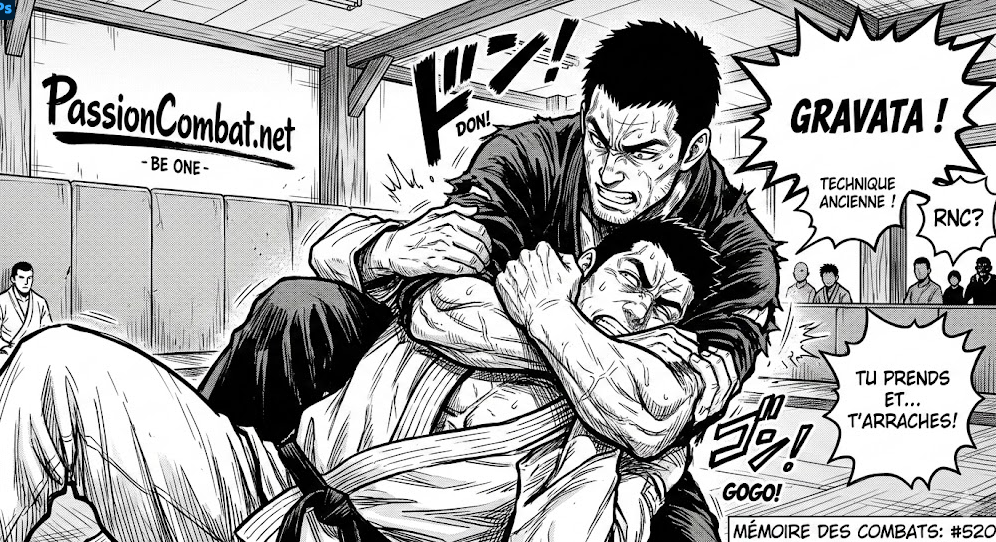
Hier, au dojo, on parlait des “guillotines” en Luta Livre et BJJ. J’expliquais qu’il y a encore quelques années, il n’y avait pas de terminologies comme Anaconda (nommé par Milton Viera) ou Brabo. La plupart du temps, c’était « la guillotine ». Ce sont les Américains qui ont commencé à donner des noms à toutes les techniques.
D’ailleurs, le Brabo Choke s’appelle aussi la D’Arce. Cela a facilité la compréhension de quel type de guillotine (ou autres techniques) on enseigne et on demande en combat. La guillotine étant, de plus, un étranglement, un contrôle de tête ou une clé de cervicale : le fameux “tu prends et… t’arraches”.
Ce qui est curieux dans l’ouvrage Choque (qui reprend les articles des affrontements interstyles et du développement des arts martiaux depuis le début du 20e siècle au Brésil), c’est que la technique qui était la plus souvent utilisée était la Gravata.
Comme il y avait des lutteurs, des catch wrestlers, des lutadors et des jiujitsukas/judokas, cette technique ressort sur beaucoup de soumissions. Et la Gravata est une guillotine, souvent prise sur les takedowns ou en quadrupédie. Ce que le jiu-jitsu des Gracie, comme celui des Japonais sur place, a un peu changé, c’est que, plus spécifiquement pour la tendance Helio Gracie, on restait sur le dos ; donc la guillotine était moins fréquente dans ces matchs.
Par contre, la prise de dos pour l’étranglement (je n’ai pas de détail, mais on peut imaginer depuis le dos au sol) était la technique qu’aussi bien Helio que George Gracie affectionnaient. Le seul souci, c’est qu’il n’est pas certain que ce soit un RNC (Rear Naked Choke) comme on le connaît aujourd’hui, parce que la Gravata, comme la guillotine, était aussi considérée par moments comme un étranglement…
L’évolution des noms est une bonne chose pour que nous puissions avoir une vision juste des techniques utilisées. Ça nous permet de mieux comprendre l’histoire du combat.
Prenez ce qui est bon et juste pour vous. Be One, Pank. https://www.passioncombat.net/
—
Martial Reflections of an Hypnofighter #520: The Gravata
Yesterday at the dojo, we were talking about “guillotines” in Luta Livre and BJJ. I explained that just a few years ago, there were no terminologies like Anaconda (named by Milton Viera) or Brabo. Most of the time, it was « the guillotine. » It was the Americans who started giving names to all the techniques.
By the way, the Brabo Choke is also called the D’Arce. This made it easier to understand what type of guillotine (or other techniques) is taught and requested in combat. The guillotine is, furthermore, a choke, a head control, or a neck crank: the famous « you grab and… you tear off. »
What is curious in the book Choque (which collects articles on interstyle matches and the development of martial arts since the beginning of the 20th century in Brazil), is that the technique that was most often used was the Gravata.
Since there were wrestlers, catch wrestlers, lutadors, and jiujitsukas/judokas, this technique stands out in many submissions. And the Gravata is a guillotine, often taken during takedowns or from the turtle position. What the Gracie Jiu-Jitsu, like the Japanese version there, changed a bit, is that, specifically for the Helio Gracie style, they preferred to stay on their back, so the guillotine was less frequent in those matches.
On the other hand, the back mount for the choke (I don’t have details, but one can imagine from the back on the ground) was the technique that both Helio and George Gracie were fond of. The only problem is that it is not certain that it was a RNC (Rear Naked Choke) as we know it today, because the Gravata, like the guillotine, was also considered at times an strangulation…
The evolution of names is a good thing so that we can have an accurate vision of the techniques used. It allows us to better understand the history of combat.
Take what is good and right for you. Be One, Pank. https://www.passioncombat.net/
 Laboratoire Hypnose