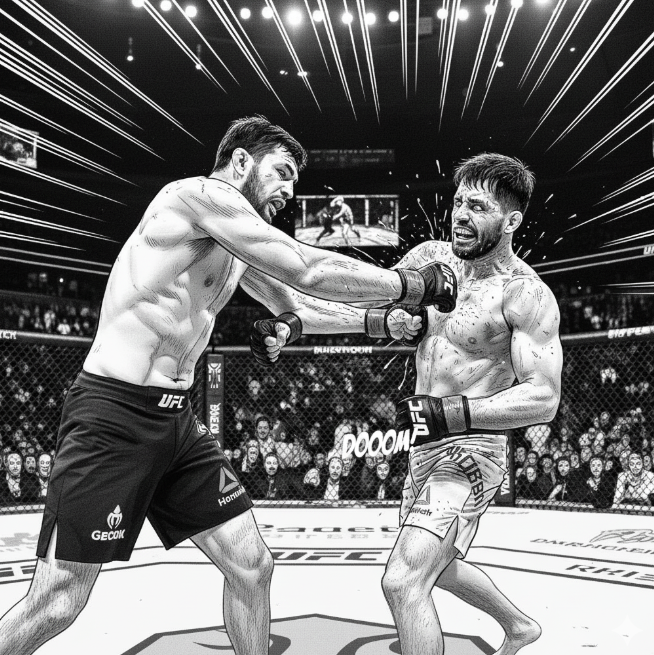
S’il y a eu de très belles phases lors de cet UFC Paris, j’ai particulièrement apprécié de voir à quel point les coups au corps ont pu changer la configuration des combats. Dans cette ère d’échanges techniques, je pense qu’il pourrait être intéressant pour les combattants de s’inspirer des frappes de poings rapprochées du Kyokushin.
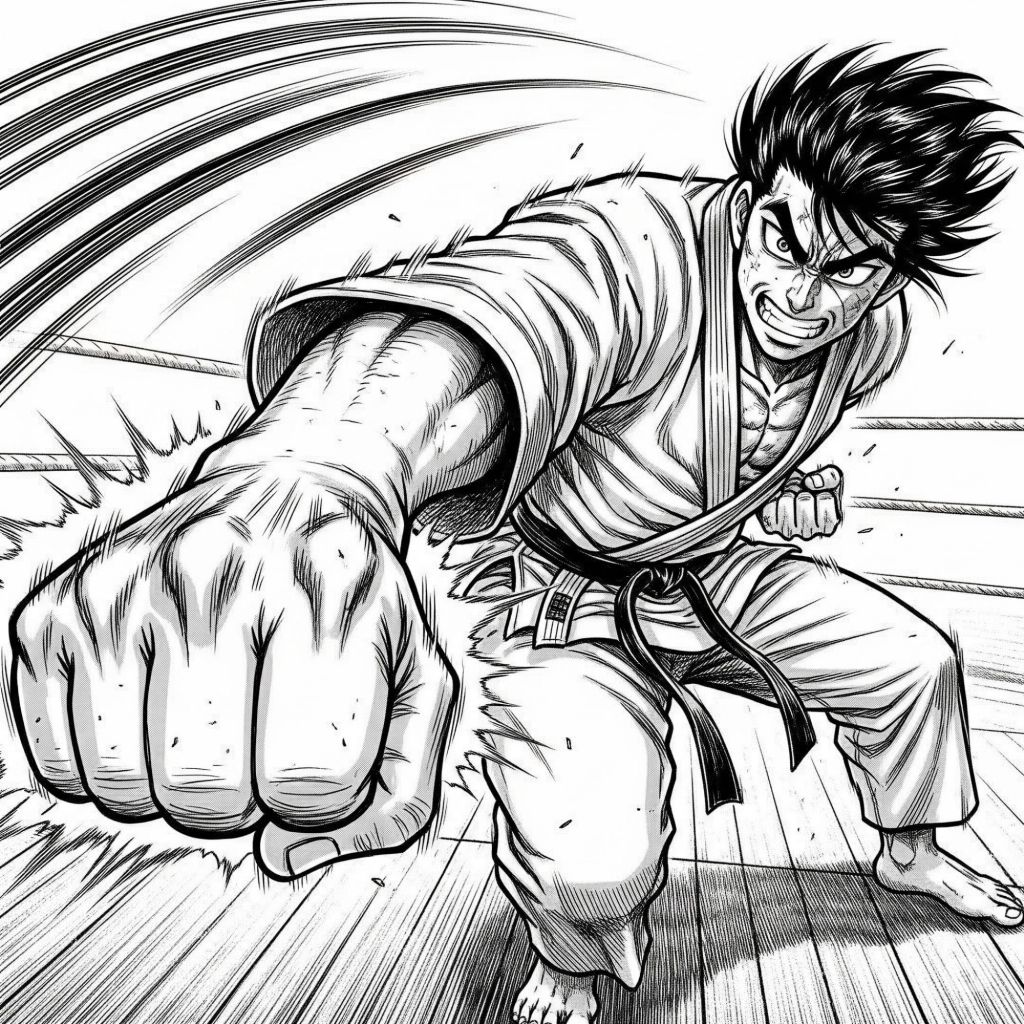
Il y a une phase qui s’apparente au clinch mais sans réellement utiliser les bras pour déséquilibrer, contrôler en lutte ou préparer un coup de genou. C’est un moment de combat où l’on est très proche de l’adversaire et où le corps est souvent plus exposé. C’est exactement dans ce type de configuration que les karatékas Kyokushin excellent.
Le travail en Shita (coups bas) est certainement une voie qui pourrait être perfectionnée, notamment les crochets aux côtes. On pourrait objecter que la boxe anglaise propose déjà cela, mais les distances sont un peu différentes et le karaté Kyokushin est spécifiquement conçu pour cette courte distance.
Les pratiquants de Kyokushin savent très bien créer des ouvertures, affaiblir l’adversaire ou le faire réagir pour enchaîner avec des coups de pieds, ou, dans le contexte du MMA, pour ouvrir la possibilité de frapper au visage ou de reprendre de la distance.
Il y a également une différence d’impact entre frapper avec des gants de boxe anglaise et avec des poings nus ou des gants de 4 onces. L’impact sur les poignets est plus important et les kento (articulations des doigts) peuvent être blessés lors de la frappe sur les coudes. C’est une manière très spécifique de frapper avec puissance au corps à très courte distance, et cela pourrait être un véritable outil supplémentaire dans l’arsenal des strikers ou des dirty wrestlers.
Encaisser les coups au corps est parfois trompeur, tout comme les coups aux jambes. Une seule frappe bien placée peut transformer ce que nous pensions pouvoir gérer en un calvaire, voire un abandon.
Prenez ce qui est bon et juste pour vous.
Be One,
Pank
Martial Reflections of a Hypnofighter #431: Body Shots
While there were some great moments in this UFC Paris, I really liked seeing how much body shots could change the dynamic of the matches. In this era of technical exchanges, I think it could be interesting for fighters to look at what Kyokushin practitioners do with their very close-range fist strikes.
There’s a phase that’s similar to the clinch but without actually using the arms to unbalance, control in wrestling, or set up a knee strike. It’s a moment in the fight where you’re very close to the opponent, and the body is often more open than in other phases of combat. It’s precisely in this configuration that Kyokushin karateka specialize.
The Shita (low strikes) work is certainly a path that could be refined, especially the rib hooks. You might say that boxing already offers this, but the distances are a bit different, and this style of karate is specifically oriented toward that short distance.
They are very good at creating openings, weakening the opponent, or making them react to follow up with kicks, or, for MMA, opening up the possibility of striking the face or regaining distance.
There’s also a difference in impact between striking with boxing gloves and with bare fists or 4 oz gloves. There is more impact on the wrists, not to mention the kento (knuckles) which can be injured from impact on the elbows. It’s a very specific way to hit the body with power at a very short distance and could be a real additional tool in the arsenal of strikers or dirty wrestlers.
Taking body shots can sometimes be tricky, just like leg kicks. Sometimes, a single well-placed strike is all it takes for what you thought you could handle to become a nightmare, or even lead to giving up.
Take what is good and right for you.
Be One,
Pank
 Laboratoire Hypnose