
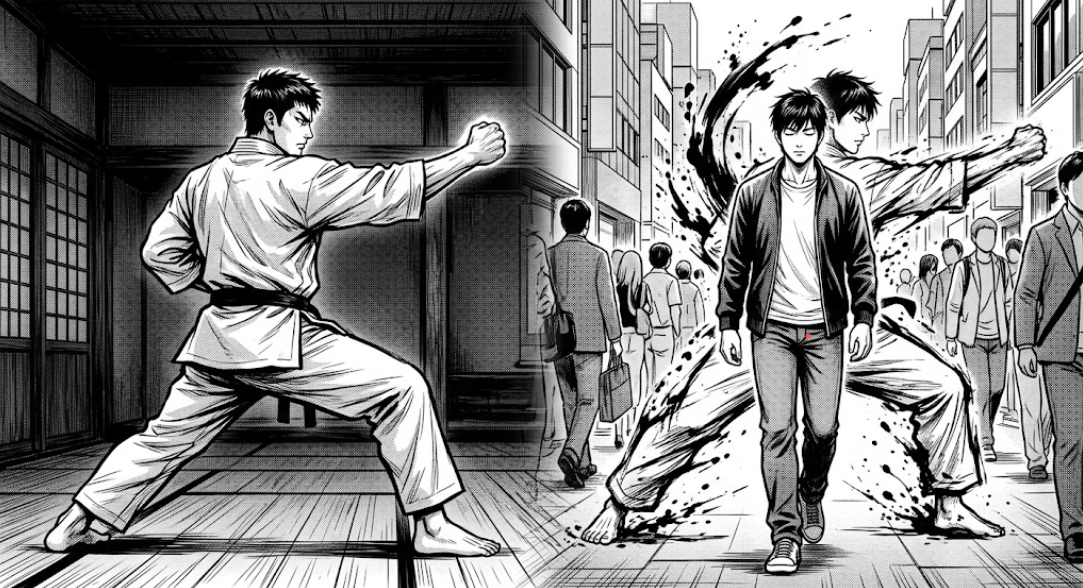
Dans la même journée, je tombe sur deux articles qui, d’une certaine façon, peuvent faire écho l’un à l’autre : un de Naka Sensei (de la JKA) dans Karate Bushido, et un autre de Chris Haueter, l’un des premiers pratiquants de BJJ aux États-Unis. Tous deux concernent « l’impact des arts martiaux » en dehors du dojo.
Naka Sensei explique que le Shugyo est une démarche de perfectionnement qui ne se limite pas au dojo : chaque situation devient une occasion d’améliorer sa technique et sa capacité d’être un homme meilleur. Cette quête visant à utiliser son karaté partout pour devenir une meilleure personne est très prisée, notamment au sein de la JKA.
Mestre Haueter, quant à lui, mettait en avant le fait qu’en tant que professeur, il ne faut pas imposer dans la vie de ses élèves les comportements attendus au dojo. Certes, l’approche est un peu différente, mais je trouve qu’elle met en lumière cette tension entre le dojo — un lieu où tout le monde se plie aux règles ou s’en va — et la liberté dans l’utilisation de la « philosophie » de l’art martial. Cela s’oppose à la vision où le karaté devient une matrice intégrale de la vie, et non simplement une activité sportive, un break, mais un engagement total.
Cependant, les deux idées gardent en ligne de mire un objectif commun : permettre à chacun de devenir l’homme ou la femme la plus « juste » dans sa vie, en se nourrissant des budos qu’il ou elle étudie.
Prenez ce qui est bon et juste pour vous. Be One, Pank. https://www.passioncombat.net/
—
Martial Reflections of a Hypnofighter #635: Shugyo or the Way Beyond the Dojo: Between Total Commitment and Individual Autonomy
On the same day, I came across two articles that, in a way, resonate with one another: one by Naka Sensei (from the JKA) in Karate Bushido, and another by Chris Haueter, one of the pioneer BJJ practitioners in the USA. Both address the « impact of martial arts » outside the dojo.
Naka Sensei explains that Shugyo is a process of self-refinement that is not confined to the dojo: every situation becomes an opportunity to improve one’s technique and one’s capacity to become a better person. This pursuit of applying karate everywhere to become a better human being is highly valued, particularly within the JKA.
Mestre Haueter, on the other hand, emphasized that instructors should not push their students to adopt dojo-specific behaviors in their personal lives. Although the perspective differs slightly, I find it highlights the nuance between the dojo — a space where everyone adheres to the rules or leaves — and the freedom to apply the martial art’s « philosophy », as opposed to a framework where karate becomes a governing blueprint for life rather than merely a sport, a break, or a total commitment.
Nevertheless, both perspectives share a common core objective: allowing each individual to become the most « upright » version of themselves in daily life, nourished by the budo they practice.
Take what is good and right for you. Be One, Pank. https://www.passioncombat.net/

