
Comme vous le lisez en ce moment, je suis dans ma phase de recherche sur le Catch Wrestling et, comme nous avons pu le voir, cet art de Wigan a pu se développer dans des formes multiples au travers du monde.
Nous voyons même des styles qui ne sont pas issus de cette école, mais qui pourtant, dans les processus, s’y apparentent sur de nombreux points. Aujourd’hui, je veux juste introduire le Sambo dans le monde japonais. Il semble que celui qui fit le lien soit un Japono-Russe, né en Mandchourie, Victor Koga.
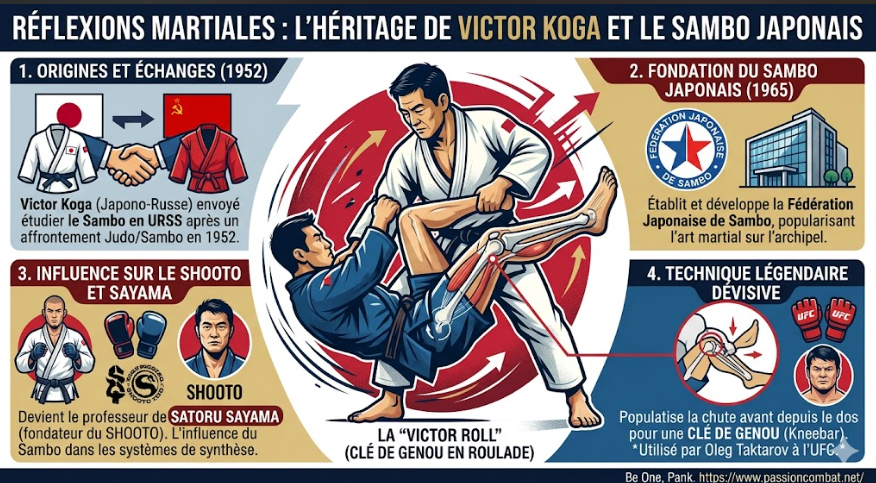
En 1952, il y a un affrontement dans les règles du Judo, opposant une équipe russe de Sambo à une équipe japonaise de Judo. Les Nippons l’emportent de peu, mais se rendent compte que la réinterprétation de leur école mérite d’être étudiée. Ils envoient Koga, qui est initialement lutteur puis judoka.
En 1965, il développe la fédération japonaise de Sambo et popularise cette discipline particulièrement agressive sur l’archipel. Il devient le professeur de Satoru Sayama, le fondateur du Shooto. Pour rappel, Sayama était striker, Pro Wrestler et avait donc une base de système lutté, mais la partie grappling du Shooto est constituée d’un peu de Sambo, de Catch Wrestling et surtout de beaucoup de Combat Wrestling du Sensei Kiguchi.
Koga est connu pour avoir enseigné une clé que nous connaissons maintenant dans les styles de grappling ou de MMA, que Taktarov avait initiée à l’UFC : une chute avant quand le partenaire est dans le dos pour partir en clé de genou.
Le Sambo est un style très respecté au Japon et on le retrouve dans énormément de styles de synthèse comme le Shooto ou le SAW.
Prenez ce qui est bon et juste pour vous. Be One, Pank. https://www.passioncombat.net/
—
Martial Reflections of an Hypnofighter #581: Victor Koga
As you read this, I am currently in my research phase regarding Catch Wrestling, and as we have observed, this art originating from Wigan has evolved into multiple iterations across the globe.
We even encounter styles that do not stem from this specific lineage yet demonstrate significant procedural similarities. Today, my objective is simply to introduce the integration of Sambo into the Japanese martial sphere. It appears the primary conduit for this connection was a Japanese-Russian born in Manchuria: Victor Koga.
In 1952, a contested event held under Judo rules pitted a Russian Sambo team against a Japanese Judo team. The Japanese secured a narrow victory but subsequently realized that the Russian reinterpretation of their foundational art warranted rigorous study. Consequently, they dispatched Koga, who possessed a background in both freestyle wrestling and Judo.
By 1965, he had established the Japanese Sambo Federation, thereby popularizing this distinctly aggressive discipline across the archipelago. He later served as the instructor for Satoru Sayama, the architect of Shooto. As a reminder, Sayama was a striker and a Pro Wrestler, thus possessing a foundational grappling base; however, the grappling component of Shooto is an amalgamation of Sambo, Catch Wrestling, and predominantly the Combat Wrestling methodologies of Sensei Kiguchi.
Koga is notably recognized for imparting a specific joint lock—now widely recognized in modern grappling and MMA, and famously utilized by Oleg Taktarov in the early UFC—involving a forward roll execution when the opponent establishes back control, transitioning directly into a kneebar.
Sambo commands immense respect in Japan and is a foundational element in numerous synthesis martial arts styles, such as Shooto and SAW.
Take what is good and right for you. Be One, Pank. https://www.passioncombat.net/

