
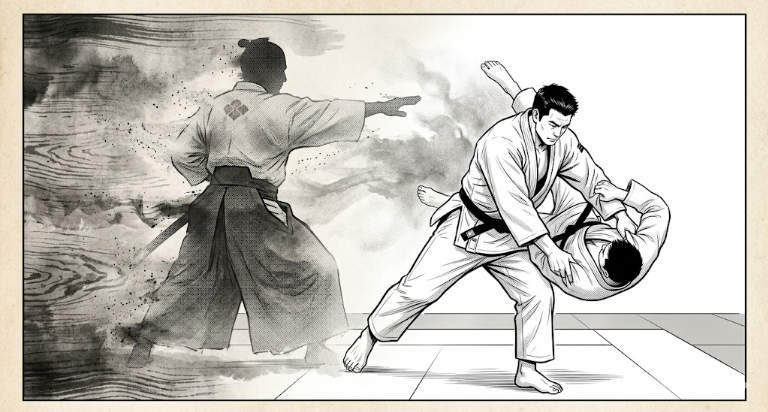
Saviez-vous que le judo a, en quelque sorte, tué un autre judo ? Lorsque Jigoro Kano a fondé le Kodokan Judo, il a choisi volontairement de retirer les techniques les plus dangereuses du jujitsu. Il estimait en effet que, tant sur le plan technique que moral, les anciens styles de jujitsu n’avaient plus leur place au sein de l’ère Meiji. Son intention était de développer un système éducatif et martial d’abord destiné aux Japonais, avant de le déployer à l’échelle internationale.
Dans cette transition cruciale entre l’époque féodale et la modernité, l’intégration du concept de dô (la Voie) est devenue l’élément déterminant pour affirmer la modernité et la supériorité institutionnelle du style de Jigoro Kano.
Pourtant, le mot « judo » lui-même existait bien avant le Kodokan, comme Kano le mentionne d’ailleurs dans ses propres écrits. Ce terme n’est pas une création de son cru. Il existait un style antérieur nommé le Jikishin-ryû Judo (que l’on retrouve également sous le nom de Jikishin-ryû). Ce système était principalement basé sur les techniques de frappe (atemi-waza) et comportait quelques projections. La philosophie de cette école reposait sur l’idée que le système devait s’adapter, guidé par des maximes telles que : « Le cœur et le corps sont la racine de toute technique. Suivre la voie de la bienveillance, de la modération et de la droiture naturelle, c’est cela le judo. »
Pour les maîtres du Jikishin-ryû, tout comme pour Kano par la suite, le combat réel n’était qu’un support à l’accomplissement de soi. Cependant, avec l’avènement et l’institutionnalisation du Kodokan au début du XXe siècle, le Jikishin-ryû a progressivement disparu. Le mot « judo » est devenu définitivement synonyme du formalisme imposé par le Kodokan. En raison de l’influence hégémonique de cette nouvelle organisation dans la région d’origine du Jikishin-ryû, le nombre de ses pratiquants s’est éteint. Aujourd’hui, seules quelques rares personnes tentent de faire survivre ce système technique ancestral, son expertise des atemi, et sa vision singulière du combat axée sur ce qu’ils nomment « l’immobilité dynamique ».
Prenez ce qui est bon et juste pour vous. Be One, Pank. https://www.passioncombat.net/
—
Martial Reflections of an Hypnofighter #576 : The Evolution of Judo: From Jigoro Kano’s Meiji Transition to the Obsolescence of Jikishin-ryû
Did you know that judo, in a sense, supplanted another form of judo? When Jigoro Kano founded Kodokan Judo, he deliberately chose to eliminate the most hazardous techniques from traditional jujitsu. He believed that, both technically and morally, the ancient schools of jujitsu no longer had a place within the modernizing Meiji era. His ultimate intention was to develop a comprehensive martial and educational system tailored first for the Japanese people, and subsequently expanded globally.
During this pivotal transition from a feudal society to a modern nation-state, the integration of the concept of dô (the Way) became the defining element used to demonstrate the modernity and institutional superiority of Kano’s methodology.
Yet, the term « judo » itself existed long before the Kodokan, as Kano explicitly acknowledged in his own writings. The word was not Kano’s creation. There was a precursor lineage known as Jikishin-ryû Judo (also referred to simply as Jikishin-ryû). This specific framework was primarily built upon striking methodologies (atemi-waza) combined with a select number of throwing techniques. The philosophy of this school dictated that the system must remain adaptable, sustaining core principles such as: « The heart and the body are the root of all technique. Following the path of benevolence, moderation, and natural righteousness—that is judo. »
For the masters of Jikishin-ryû, much like for Kano later on, actual combat was merely a vehicle for self-cultivation. However, with the rise and institutionalization of the Kodokan at the turn of the 20th century, Jikishin-ryû gradually faded into obscurity. The word « judo » became exclusively associated with the standardized formalism of the Kodokan. Due to the overwhelming domestic influence of Kano’s institution in the native region of Jikishin-ryû, active practitioners eventually vanished. Today, only a handful of individuals attempt to preserve this ancestral technical system, its specific expertise in atemi, and its unique perspective on combat centered around what they term « dynamic immobility. »
Take what is good and right for you. Be One, Pank. https://www.passioncombat.net/
 Laboratoire Hypnose