
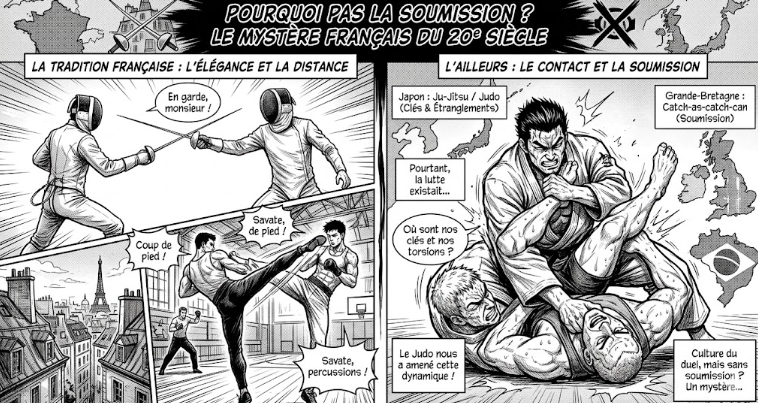
Dans le cadre de mes recherches sur les luttes à soumission, je m’interroge sur les raisons pour lesquelles la France n’a pas développé un tel système au cours du XXe siècle, alors même que la lutte à soumission y existait sous d’autres formes.
Je sais qu’en France, il existe une grande diversité de luttes régionales. Je sais également que la lutte gréco-romaine est en partie issue des luttes parisiennes, combinées à quelques modifications techniques provenant d’autres styles. Cependant, à l’inverse des Britanniques et de leur synthèse à travers le catch-as-catch-can (ou catch wrestling), qui intégrait des soumissions, nous n’avions pas de système de combat combinant la lutte avec des clés, des étranglements ou des torsions.
Quand je fais référence au XXe siècle, c’est parce que l’on observe aux États-Unis, au Brésil, au Japon et en Chine (avec le shuai jiao et les styles connexes) l’émergence de systèmes orientés vers les luttes à soumission. Or, en France, pour une raison que j’ignore encore, il ne semble pas y avoir eu, pendant un siècle, de volonté de développer un style permettant la soumission.
Ce sont d’ailleurs le judo et le ju-jitsu qui ont apporté cette dynamique du combat au sol avec clés ou étranglements. Qu’est-ce qui, dans notre culture, explique que nous n’ayons pas décidé d’aller jusqu’à la soumission de l’adversaire ? Et ce, alors même que nous disposions de styles comme la savate (axée sur les percussions), de grands maîtres d’armes et d’excellents systèmes de lutte, dans un pays qui, historiquement, appréciait les duels et valorisait les combats d’orgueil.
Prenez ce qui est bon et juste pour vous. Be One, Pank. https://www.passioncombat.net/
—
Martial Reflections of an Hypnofighter #573 :The Cultural Exception of French Combat Sports: The Absence of a Native Submission Grappling System in the 20th Century
Within the scope of my research on submission grappling, I am questioning why France failed to develop a native submission-based system during the 20th century, despite the historical existence of grappling within the country.
I am aware that France possesses a rich diversity of regional grappling styles. I also know that Greco-Roman wrestling stems partly from Parisian wrestling styles, combined with technical modifications derived from other disciplines. However, unlike the British and their synthesis through catch-as-catch-can (or catch wrestling), which featured submission holds, France lacked a combat system that integrated wrestling with joint locks, strangulations, or twisting locks.
My focus on the 20th century is motivated by the observation that the United States, Brazil, Japan, and China (with shuai jiao and related arts) all witnessed the institutionalization of systems evolving toward submission grappling. Yet, in France, for reasons still unknown to me, there appeared to be no driving ambition throughout the century to develop a discipline dedicated to forcing an opponent to submit.
In fact, it was the introduction of Japanese judo and ju-jitsu that brought this dynamic of ground fighting, joint locks, and chokeholds into the French martial landscape. What cultural factors explain why, despite possessing combat arts such as savate (focused on striking), world-class masters of arms, and excellent regional wrestling systems, France culturally chose not to pursue the mechanics of submission? This remains particularly paradoxical for a nation that historically favored duels and frequently engaged in bouts driven by honor and pride.
Take what is good and true for you. Be One, Pank. https://www.passioncombat.net/
 Laboratoire Hypnose