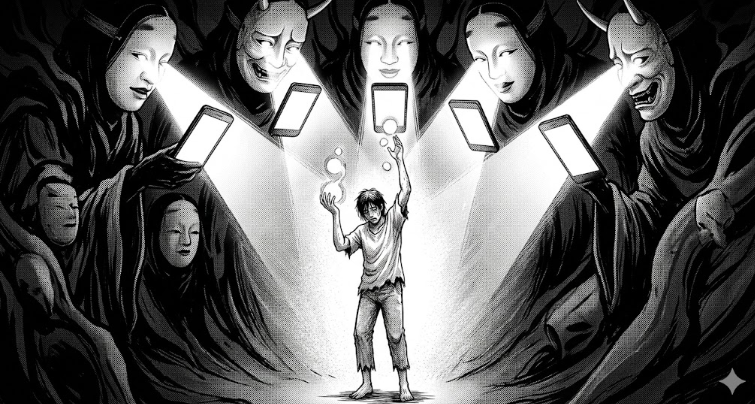
Les dangers du besoin de reconnaissance nécessitent d’être identifiés. Il est vrai que nous pourrions imputer la plupart des problèmes actuels à un seul élément : celui du besoin d’être connu et reconnu. Je reprends ici la notion d’Eric Berne en Analyse Transactionnelle (AT). Il est intéressant pour nous de nous questionner sur ce besoin d’unité de reconnaissance qu’on appelle les « strokes » (ou signes de reconnaissance). Nous savons, d’après Berne, mais nous le constatons également au quotidien, que nous pouvons jouer à des jeux psychologiques, mettre des masques pour soutirer de l’attention (plus ou moins qualitative), voire même aller jusqu’à quémander de l’amour, pour nourrir quelque chose en nous. Pour nourrir le fait qu’une ou plusieurs personnes puissent reconnaître notre existence.
Nous pourrions rebondir sur ce que Taibi Kahler a proposé avec la Process Communication (Process Com), et dire qu’il peut y avoir un besoin de reconnaissance au travail, un besoin de reconnaissance de la personne, ou un besoin de reconnaissance de sa pensée. En tout cas, nous pouvons facilement constater que, poussés plus ou moins consciemment par ce besoin de reconnaissance, nous sommes capables d’écraser, d’aimer, de tuer, d’écouter, de nous oublier ou de faire taire les autres.
Ce qui est assez fascinant avec l’ère moderne, c’est que les réseaux sociaux nous montrent à quel point ce besoin de reconnaissance se retrouve partout. Et si, aujourd’hui, nous pouvons constater une hausse des incivilités et de la violence par rapport à il y a quelques décennies, c’est justement parce que cette quête existe et se transmet de manière virale via les vidéos publiées. Cette notion qui crie : « Reconnaissez-moi, regardez comme j’ai été amusant, énervé, fort, beau, belle, intelligente, etc. ». Si nous travaillions un peu sur le besoin de reconnaissance, nous commencerions peut-être à modifier certains schémas, particulièrement dissonants, inhérents à nos systèmes sociaux.
Prenez ce qui est bon et juste pour vous. Be One, Pank. https://www.pank.one/blog
Pank’s Reflections / Snapshot n°574 : The Paradox of the Need for Recognition: From Transactional Analysis to the Digital Age
The dangers associated with the need for recognition must be properly identified. Indeed, we could attribute the majority of contemporary issues to a single fundamental factor: the need to be known and acknowledged. I am referring here to Eric Berne’s concepts in Transactional Analysis (TA). It is highly relevant for us to examine this drive for units of recognition, which are termed « strokes. » As Berne theorized—and as we observe on a daily basis—we know that we are capable of playing psychological games, wearing masks to extract varying degrees of attention, and even going so far as to beg for love, all to nourish a void within ourselves. We do this to validate the fact that one or more individuals acknowledge our existence.
We could also draw upon Taibi Kahler’s propositions in the Process Communication Model (PCM), noting that there can be a need for recognition of one’s work, a need for recognition of oneself as a person, or a need for recognition of one’s beliefs and thoughts. Regardless of the specific form, it is easily observable that, driven more or less subconsciously by this need for recognition, human beings are capable of crushing, loving, killing, listening, neglecting themselves, or silencing others.
What is particularly striking about the modern era is how social media platforms highlight the pervasive nature of this need for recognition. If we observe an increase in incivility and violence today compared to a few decades ago, it is precisely because this underlying quest exists and is virally transmitted through uploaded video content. It is a concept that loudly broadcasts: « Acknowledge me, look at how funny, angry, strong, handsome, beautiful, or intelligent I was, etc. » If we were to critically address and work on this need for recognition, we might begin to alter certain highly dissonant behavioral patterns embedded within our societal systems.
Take what is good and right for you. Be One, Pank. https://www.pank.one/blog.

