
Je parlais cette semaine des pratiques que beaucoup n’aiment pas du tout en jiu-jitsu, comme le fait de mettre la main sur le visage, l’usage des coudes, et toutes sortes de techniques similaires. On peut penser notamment au fait de prendre la position « cravate » (le catch-as-catch-can ou headlock), qui est d’ailleurs rarement validée dans ce milieu, l’exécutant étant alors considéré comme un lutador plutôt que comme un jiu-jitsuka. Il est assez amusant de voir à quel point le discours ambiant peut qualifier cela de « style bourrin », une approche que je trouve personnellement très chouette. Néanmoins, cela démontre simplement que l’expression technique en randori ou en sparring diffère entre la Luta Livre, le catch wrestling et le Jiu-Jitsu.
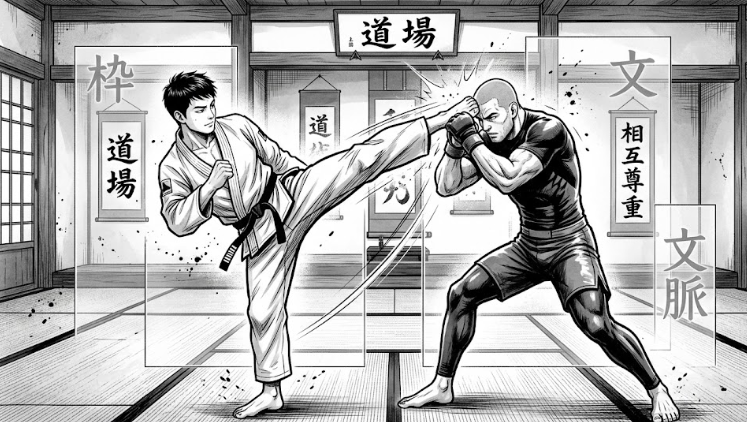
Il n’y a pas de meilleure ou de moins bonne approche ; il y a simplement une façon d’aborder le combat qui change. Tout comme pour les nak muay en Muay-Thaï, où recevoir un front kick (teep) en pleine tête peut être très mal vu. En Thaïlande, toucher la tête avec les pieds est considéré comme profondément irrespectueux. À l’inverse, étant issu du karaté, recevoir un mae geri (coup de pied direct au visage) ou un mawashi geri (coup de pied circulaire au visage) appelait plutôt comme réponse OSU, entre guillemets : « Bravo, tu as réussi à placer ta technique. »
Il est crucial de se rendre compte à quel point certaines attitudes peuvent être perçues comme désobligeantes par certaines personnes, alors qu’elles ne contiennent aucune agressivité intrinsèque ni aucun manque de respect envers le style ou l’opposant. C’est un phénomène fascinant et parfois imprévisible. Lorsque je fais travailler les heel hooks (clés de talon) à mes ceintures blanches en jiu-jitsu, il est difficile pour eux d’en anticiper la portée culturelle. Bien sûr, je les préviens que dans d’autres académies, le heel hook est strictement interdit, d’autant plus en kimono et pour des ceintures blanches. Tout est une question de cadre dans lequel on partage sa pratique.
Prenez ce qui est bon et juste pour vous. Be One, Pank. https://www.passioncombat.net/
—
Martial Reflections of a Hypnofighter #569 :Cultural and Technical Relativity in Combat Arts: Norms, Frameworks, and Perceptions of Respect
This week, I was discussing practices that are widely disliked by many in jiu-jitsu, such as placing a hand on the opponent’s face, utilizing elbows, and various similar techniques. A prime example is using the « cravate » (headlock/front headlock), a technique rarely validated within this specific community, where the practitioner is often labeled a lutador rather than a true jiu-jitsuka. It is quite amusing to observe how prevailing discourse tends to categorize this as a « brutish style »—an approach I personally find highly appealing. Nevertheless, this variation simply demonstrates that the technical expression during randori or sparring obeys different paradigms in Luta Livre, catch wrestling, and Jiu-Jitsu.
There is no inherent hierarchy of superior or inferior methods; there is merely a shifting paradigm in how combat is approached. A parallel can be drawn with nak muay in Muay Thai, where receiving a front kick (teep) directly to the face can be highly frowned upon. In Thailand, targeting the head with the feet is culturally perceived as deeply disrespectful. Conversely, coming from a karate background, executing or receiving a mae geri (front snap kick to the face) or a mawashi geri (roundhouse kick to the head) would typically OSU elicit a response akin to: « Well done, you managed to successfully land your technique. »
It is essential to recognize how certain actions can be deemed offensive by some practitioners, despite lacking any intrinsic malice, aggressiveness, or disrespect toward the style or the opponent. This subjective friction is a fascinating and unpredictable phenomenon. For instance, when I introduce white belts to heel hooks in jiu-jitsu, it is difficult for them to anticipate the stylistic taboo surrounding it. Naturally, I explicitly warn them that in other academies, the heel hook is strictly prohibited, especially when training in a Gi and at the white belt level. Ultimately, everything depends on the specific pedagogical and cultural framework within which the practice is shared.
Take what is good and right for you. Be One, Pank. https://www.passioncombat.net/

