
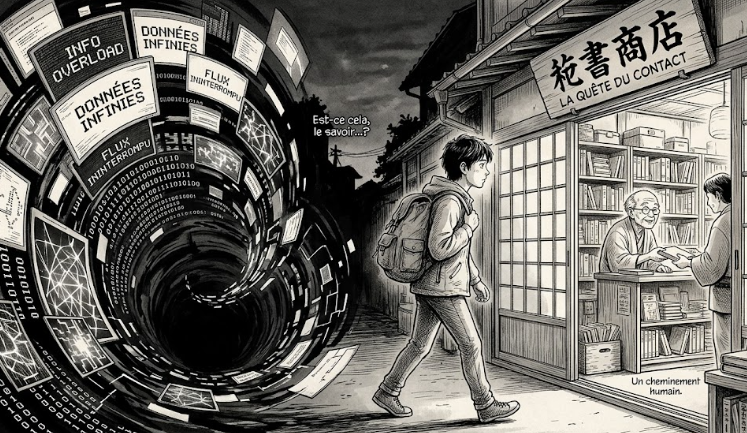
La valeur la plus importante pour le futur ? Le contact. Aujourd’hui, nous pouvons constater que nous sommes constamment sous un flux d’informations et de données qui nous donnent l’impression d’entrer dans un chemin de connaissances et de compréhension, à la fois de nous-mêmes et des autres. Pourtant, il arrive que nous nous isolions de plus en plus. Et si, par le passé, nous avions l’occasion d’aller en bibliothèque ou en médiathèque pour chercher un ouvrage, voire, pour certains, en librairie, c’était un lieu où il y avait de l’humain. La rencontre — souvenez-vous même de la Fnac qui a énormément joué sur ce rapport de spécialistes, ce rapport avec l’humain.
Nous avions dans cette quête de connaissances, ou simplement dans ce besoin que nous éprouvions à ce moment-là, un cheminement. Un cheminement qui menait au contact. Un cheminement qui nous permettait de vivre quelque chose qui allait au-delà du simple livre que nous venions chercher. Il y avait une sorte de quête. Il y avait, derrière tout cela, une perception de la qualité de l’information que nous étions allés chasser.
Et puis, il y a eu, au fur et à mesure, la facilité d’accès à la connaissance. C’est une chose extraordinaire, sublime même. Seulement aujourd’hui, on a trop. Trop de tout. On le sait avec les courants minimalistes, mais ne pourrait-on pas, si l’on ne peut diminuer l’ensemble des données que nous recevons dans une vie, trouver quelque chose de plus simple ? Sortir de la facette du numérique, qui, elle, est infinie (à l’instar de la célèbre formule de Nokia connectant les gens), et retourner vers quelque chose de fini. Quelque chose qui doute, qui se loupe, qui n’apporte peut-être pas la meilleure des réponses, mais qui, au bout du compte, reste humain. Et qui nous crée un contact.
Prenez ce qui est bon et juste pour vous. Be One, Pank. https://www.pank.one/blog
—
Pank’s Reflections / Snapshot n°572 : The Quest for Connection: Confronting the Digital Infoxication through a Return to the Finite and the Human
What is the most critical value for the future? Human connection. Today, we observe that we are perpetually subjected to a continuous influx of information and data, generating the illusion of embarking on a path toward deeper knowledge and mutual understanding, both of ourselves and of others. Paradoxically, this phenomenon often leads to increased social isolation. In the past, visiting a library, a media center, or a bookstore to retrieve a volume represented an engagement with a deeply human environment. This interpersonal encounter—exemplified historically by retail strategies like those of Fnac, which capitalized on the expertise of specialists—anchored the experience in human relationality.
Within this pursuit of knowledge, or simply within the psychological need experienced at that juncture, existed a structured progression—a journey that inevitably culminated in physical and social contact. This process allowed individuals to experience an event that transcended the mere acquisition of a physical book. It constituted a form of quest, underpinned by a distinct perception of the quality of the information being sought.
Subsequently, technological evolution facilitated unprecedented accessibility to knowledge—a remarkable, indeed sublime, advancement. However, contemporary society now faces an overabundance: an excess of everything. While minimalist movements attempt to address this saturation, a fundamental question arises: if we cannot reduce the aggregate volume of data received throughout a lifetime, is there not a simpler alternative? Specifically, to detach ourselves from the infinite paradigm of the digital realm and return to a finite existence. An existence that allows for doubt, error, and suboptimal answers, but which ultimately remains profoundly human and fosters genuine connection.
Take what is good and right for you. Be One, Pank. https://www.pank.one/blog

