
C’est assez amusant : il y a peu de temps, un jeune influenceur TikTok s’est amusé à rencontrer un Sensei d’Aïkido. Il a été un peu perturbé par le principe même de la discipline qui, contrairement au Jiu-Jitsu Brésilien ou à d’autres systèmes, ne repose pas sur l’opposition. À la fin de son interview, j’ai trouvé le Sensei particulièrement lucide en soulignant le fait qu’aujourd’hui, quasiment plus aucun jeune ne pratique l’Aïkido. Léo Tamaki l’avait déjà mentionné : il existe un risque que l’Aïkido s’endorme, voire disparaisse.
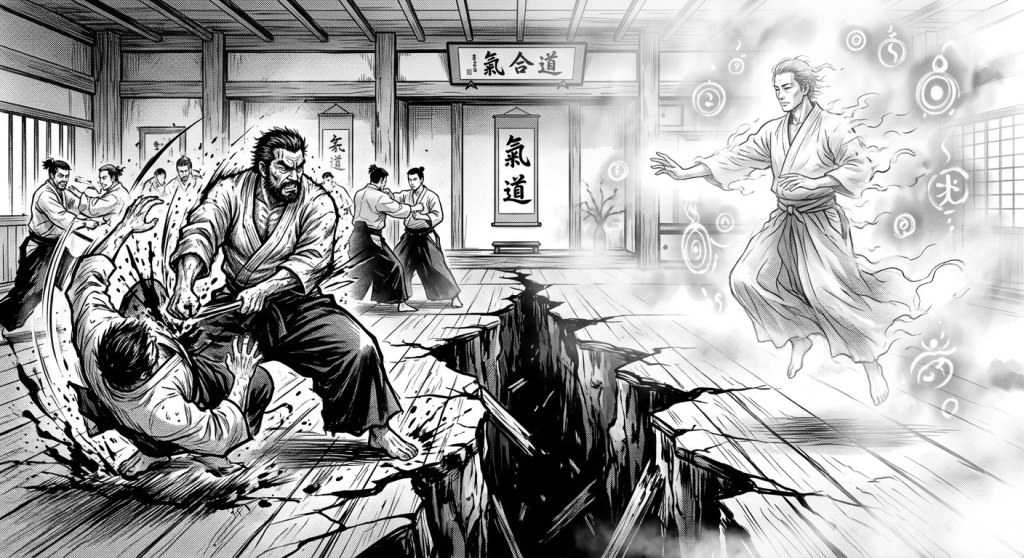
Ce qui m’étonne, c’est qu’à l’époque de Jigoro Kano comme de Morihei Ueshiba, l’Aïkido était surnommé le « Dojo de l’Enfer » pour ce qu’il représentait. Beaucoup de judokas, des combattants aguerris, allaient s’y entraîner. Je pense régulièrement à Kenji Tomiki, qui s’est entraîné avec Ueshiba et considérait ces entraînements comme hautement qualitatifs. Pour des experts atteignant le 6e, 7e ou 8e Dan de Judo, réaliser que l’Aïkido était dangereux, complexe, et qu’il neutralisait même une partie de leur Judo, démontrait une forme martiale fascinante.
Nous avons également vu Gozo Shioda, du Yoshinkan, mettre en avant un ensemble de techniques particulièrement intéressantes, bien que son système soit plus proche de la lutte ou du Judo que de l’Aïkido de fin de vie d’Ueshiba. On sait que ce dernier a traversé plusieurs phases : un Aïkido limite mystique sur la fin, et un Aïkido de guerre, beaucoup plus dur, à ses débuts. Pourtant, même en regardant le Daito-ryu, on constate que l’efficacité est difficile à évaluer car il n’y a pas de randori (combat libre) ni de phase d’opposition, contrairement à ce qu’a créé Kano pour le Judo.
L’Aïkido possède des aspects martiaux intéressants. Cependant, l’absence de randori (hormis dans le style Tomiki) fait peser aujourd’hui un risque majeur : celui que cette pratique s’étiole et finisse par s’endormir définitivement. »
Prenez ce qui est bon et juste pour vous. Be One, Pank. https://www.passioncombat.net/
—
Martial Reflections of a Hypnofighter #562: Aikido at a Crossroads: Martial Heritage and the Risk of Obsolescence
It is quite intriguing: recently, a young TikToker met with an Aikido Sensei. He was somewhat unsettled by the core principle of the discipline which, unlike Brazilian Jiu-Jitsu or other systems, is not based on direct opposition. By the end of the interview, I found the Sensei remarkably lucid in pointing out that today, almost no young people practice Aikido anymore. Leo Tamaki had already noted this: there is a risk that Aikido may fall into a slumber, or even fade away.
What surprises me is that during the eras of Jigoro Kano and Morihei Ueshiba, the practice was known as the ‘Hell Dojo’ because of its intensity. Many judokas, seasoned fighters, went there to train. I often think of Kenji Tomiki, who studied under Ueshiba and considered the training to be of the highest quality. For experts reaching the 6th, 7th, or 8th Dan in Judo, realizing that Aikido was dangerous, complex, and capable of neutralizing parts of their own Judo, proved it was a formidable martial form.
We also saw Gozo Shioda of the Yoshinkan school highlight a set of techniques that were highly effective, though his system resembled wrestling or Judo more closely than the Aikido Ueshiba practiced toward the end of his life. It is well known that Ueshiba went through several phases: a near-mystical Aikido at the end, and a much harsher ‘war-time’ Aikido in his earlier years. Yet, even when examining Daito-ryu, one finds that combat effectiveness is difficult to quantify due to the lack of randori (free sparring) and live opposition—the very elements Kano integrated into Judo.
Aikido possesses compelling martial aspects. However, without randori (except in the Tomiki style), there is a significant risk today that the practice will slowly stagnate and eventually go dormant. »
Take what is good and right for you. Be One, Pank. https://www.passioncombat.net/

