
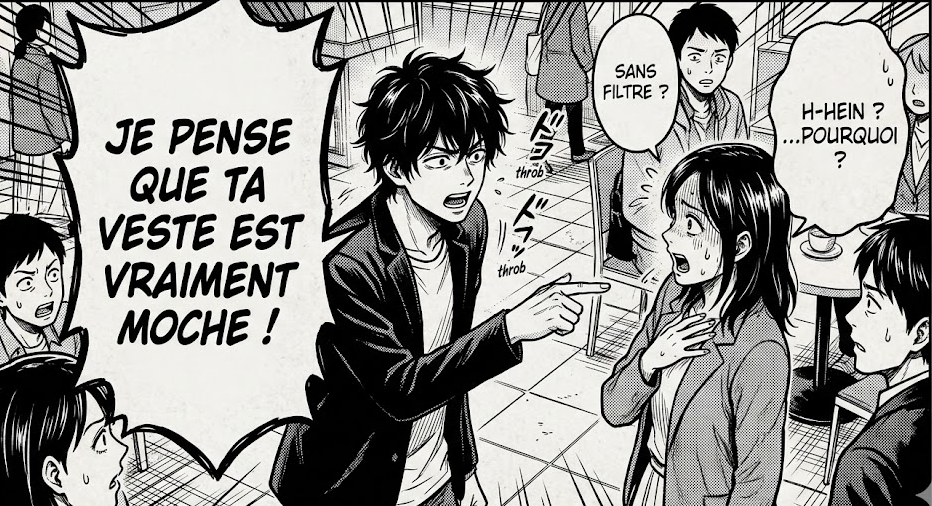
On était radical. Vous est-il déjà arrivé de tenter de dire tout ce que vous pensiez, sans filtre, pendant un certain temps ? C’est l’expérience que le psychologue Brad Blanton a proposée à travers ce qu’il nomme le « Radical Honesty » (l’honnêteté radicale). J’ai testé ce mode de fonctionnement il y a quelques années, et mon verdict est sans appel : cela ne fonctionne pas du tout.
S’il peut sembler amusant de se dire « Tiens, je vais pouvoir exprimer tout ce qui me passe par la tête à propos d’un sujet ou d’une personne à un instant T », même si cela n’a aucun rapport avec la conversation en cours, le résultat est déroutant. On pourrait avoir une sorte d’impression de psychose, comme si la personne exprimait ses pensées brutes, sans structure claire.
Alors, si l’idée est de libérer l’individu et de lui permettre d’être lui-même, il ne faut pas oublier le récepteur. L’interlocuteur, lui, n’a rien demandé. Il ne comprend absolument pas pourquoi vous lui faites soudainement une remarque sur sa veste ou pourquoi vous parlez de quelque chose dont il n’a que faire. Parfois même, vous n’avez aucun contact, aucune connaissance avec cette personne-là ; il y a juste sa présence et une pensée fugace qui traverse votre esprit.
Si l’on revient sur cette idée d’être « librement soi », il faudrait analyser ce Radical Honesty en se demandant combien de personnes pourraient réellement fonctionner de cette façon. Pourtant, on se rend bien compte que quasiment personne ne le fait. Et si c’était le cas, on se demanderait très souvent si cela ne relève pas d’un trouble psychopathologique.
Si notre société a créé des codes, des règles et des lois, c’est pour instaurer une forme d’homéostasie et un équilibre où chacun peut s’exprimer au mieux. L’objectif est d’offrir la possibilité d’une expression de soi sans pour autant basculer dans l’agression vis-à-vis d’autrui. Le Radical Honesty est une idée intéressante sur le papier, mais elle est certainement impossible à appliquer dans notre vie actuelle.
Prenez ce qui est bon et juste pour vous. Be One, Pank. https://www.pank.one/blog
—
Pank’s Reflections / Snapshot #549: Radical Honesty: An Intriguing Idea, but Is Unfiltered Honesty Socially Viable?
We were radical. Have you ever tried saying absolutely everything you think, without a filter, for a certain period? This is the experiment that psychologist Brad Blanton proposed through what he calls « Radical Honesty. » I tested this way of functioning a few years ago, and my verdict is clear: it doesn’t work at all.
While it might seem fun to think, « Hey, I’m going to express whatever pops into my head about a subject or a person at a given moment, » even if it has nothing to do with the current conversation, the result is bewildering. One could get a kind of impression of psychosis, as if the person were just blurting out raw thoughts without any clear structure.
So, if the goal is to free the individual and allow everyone to be themselves, one mustn’t forget the receiver. The listener, on the other hand, didn’t ask for any of this. They don’t understand at all why you’re suddenly making a comment about their jacket, or why you’re talking about something they have no interest in. Sometimes, you have no contact, no prior acquaintance with that person; there’s just their presence and a fleeting thought that crosses your mind.
If we return to this idea of being « freely oneself, » one would need to analyze this Radical Honesty and ask how many people could actually function this way. Yet, it’s plain to see that almost no one does. And if they did, one would very often wonder if it didn’t stem from a psychopathological issue.
If our society created codes, rules, and laws, it was to establish a form of homeostasis and a balance where everyone can express themselves as best as possible. The goal is to offer the possibility of self-expression without shifting into aggression towards others. Radical Honesty is an interesting idea on paper, but it is surely impossible to apply in current life.
Take what is good and right for you. Be One, Pank. https://www.pank.one/blog

