
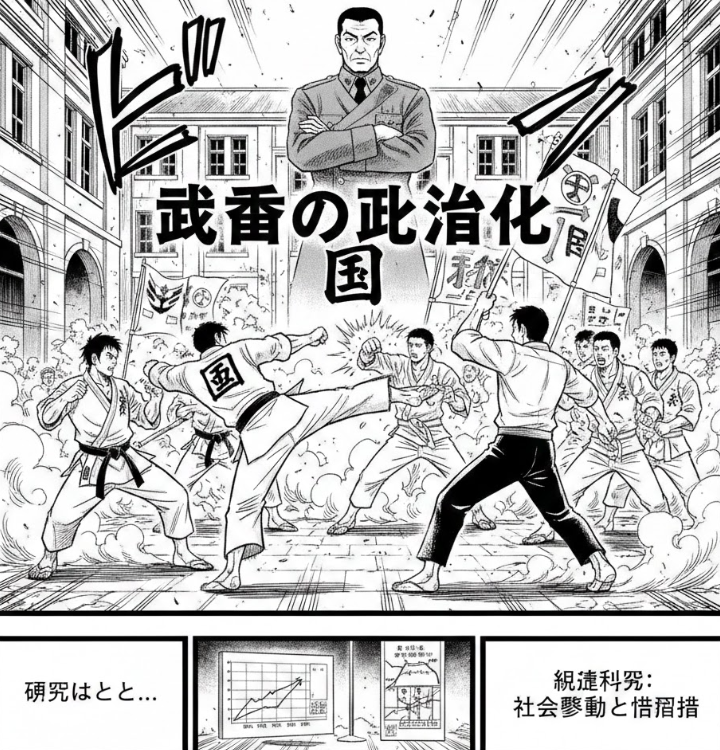
Les rixes et combats violents, voire mortels, font partie de l’histoire des arts martiaux. Nous pouvons facilement oublier que les boxes ou les luttes, sans même parler des armes, ont pour objectifs le combat, la domination physique et psychologique sur les opposants.
Quand on lit ce qui se passe régulièrement, avec des conséquences comme la mort de groupes politiques des deux côtés de l’échiquier, c’est malheureusement ce à quoi le combat peut mener.
Et les arts martiaux sont souvent associés à des idées nationalistes. On l’oublie parfois avec la mondialisation des systèmes et des cultures, mais pour reprendre le Japon pour exemple, le Shorinji Kempo de So Doshin a réussi sa diffusion initiale avec deux éléments clefs. Aider les jeunes hommes de la nation nippone (qui était, pour rappel, membre de l’Axe) à être plus solides et pouvoir aider la nation et également, dans un deuxième temps, à partir des années 50-60, s’inscrire dans le monde scolaire et universitaire.
Les membres du Shorinji étudiants se trouvaient dans toutes les universités et étaient au service de mouvements nationalistes. Pendant les années 68, ils utilisaient leurs connaissances pour cogner les franges plus à gauche des étudiants (cf. la guerre avec le Kyokushin dont je vous parlais).
Si un dojo cherche une neutralité, avec un uniforme et une conformité, il est aussi important de connaître l’intention des fondateurs (qui peuvent évoluer) et aussi prendre conscience que ce qui est enseigné pourra être utilisé avec des intentions idéologiques et politiques pour agresser ceux qui ne pensent pas pareil ou pour obtenir des biens divers.
Les sports de combat ne sont pas une discipline neutre et entraînent dans le quotidien des conséquences possibles. Oui, il n’y a pas besoin d’arts martiaux pour se battre, mais beaucoup de groupes politisés se forment désormais en MMA, en plus du matériel qu’ils vont avoir lors de « meetings ».
Prenez ce qui est bon et juste pour vous. Be One, Pank. https://www.passioncombat.net/
—
Martial Reflections of a Hypnofighter #513: Politicized Martial Arts
Brawls and violent, even deadly, fights are part of the history of martial arts. We can easily forget that boxing or wrestling, not to mention weapons, have the objectives of combat, physical and psychological domination over opponents.
When we read what regularly happens, with consequences such as the death of political groups on both sides of the spectrum, this is unfortunately what combat can lead to.
And martial arts are often associated with nationalist ideas. We sometimes forget this with the globalization of systems and cultures, but to take Japan as an example, So Doshin’s Shorinji Kempo achieved its initial spread with two key elements. Helping young Japanese men (who, let’s remember, were members of the Axis) to be stronger and able to help the nation and also, in a second phase from the 1950s-60s, integrating into the school and university world.
Student members of Shorinji were found in all universities and served nationalist movements. During the 1968 years, they used their knowledge to beat up the more left-leaning fringes of students (cf. the war with Kyokushin I mentioned).
If a dojo seeks neutrality, with a uniform and conformity, it is also important to know the founders’ intentions (which can evolve) and also to realize that what is taught can be used with ideological and political intentions to attack those who do not think similarly or to obtain various goods.
Combat sports are not a neutral discipline and lead to possible daily consequences. Yes, there is no need for martial arts to fight, but many politicized groups are now forming in MMA, in addition to the equipment they will have during « meetings. »
Take what is good and right for you. Be One, Pank. https://www.passioncombat.net/
 Laboratoire Hypnose