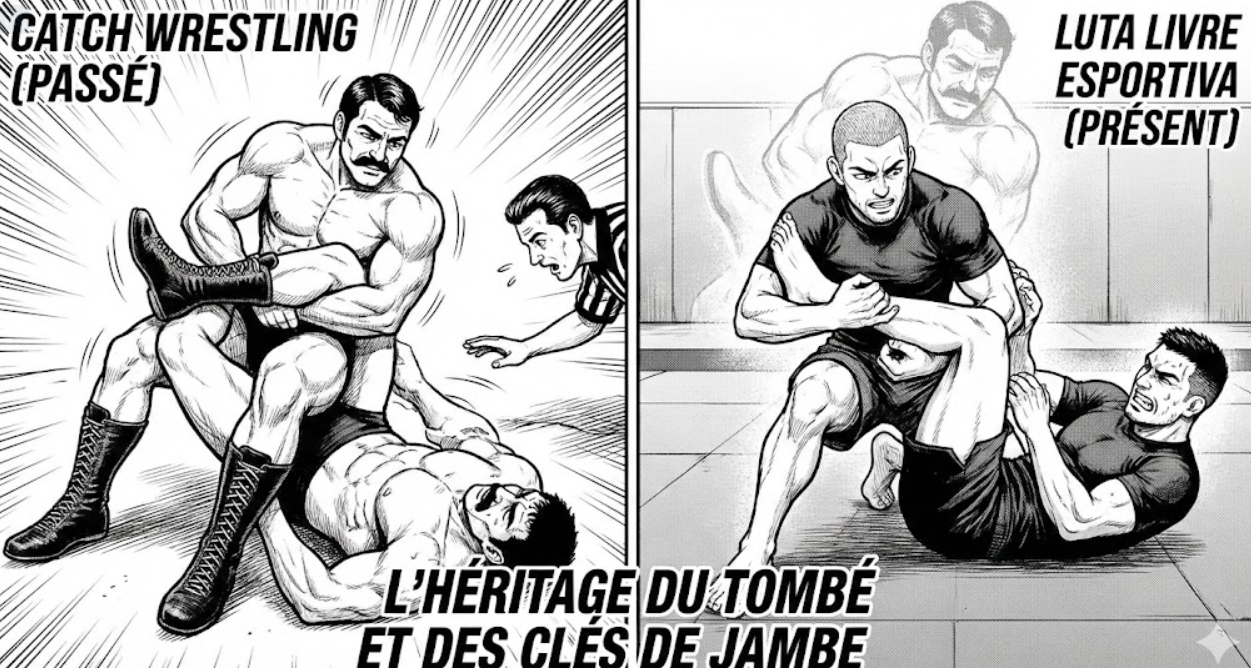
Où se trouvent les chaussures en Luta Livre Esportiva ? Je me pose cette simple question : comment se fait-il qu’aujourd’hui, la Luta Livre, telle que Tatu a pu la partager, se pratique sans chaussures ? Je vous rappelle que Tatu était un élève du combattant et professeur de Catch Wrestling Manoel Rufino Dos Santos. Un style qui, lui, porte des chaussures. Je vais chercher l’information…
En tout cas, l’utilisation des chaussures, tout comme la règle du « tombé » (pinfall), explique la forme si particulière qu’a prise l’expression compétitive du Catch Wrestling. Cela a dû également influencer la Luta Livre, dont on aime dire qu’elle avait une spécialité de clés de jambe. Si on étudie un peu le CACC (Catch-As-Catch-Can), on se rend compte que les jambes étaient énormément utilisées pour mettre des crochets, les tirer ou les tordre afin de chercher le tombé.
Vous pouvez d’ailleurs le voir en Lutte universitaire, où souvent les jeunes se mettent sur le ventre (comme au judo) ou en quadrupédie pour éviter le tombé. Les nelsons (crochets de bras) ou les attaques sur les pieds sont alors les seuls moyens efficaces pour les retourner (voire, si l’on est colossal, l’arraché). La prise de dos pour étrangler n’y existe pas.
Ceci explique sûrement pourquoi les Lutadores étaient initialement moins des passeurs de garde que des attaquants de jambes. Par extension, on peut comprendre, par la forme de la lutte de Wigan, pourquoi les guillotines sont tant utilisées dans la Luta Livre. Un autre vestige du CACC que tous les élèves de Flavio Santiago Peroba (FST) ont vécu avec le mantra : « Ne mets jamais ton dos au sol, n’accepte pas ».
Nous revenons sur le danger du tombé. Pendant des décennies, dans les divers combats de lutte qui pouvaient se faire sous des règles mixtes (Judo/Jiu-jitsu, gréco, libre ou Vale Tudo), le tombé pouvait très souvent mettre fin au combat. Par conséquent, cela n’offrait pas de temps pour rester sur le dos et travailler, mais incitait à vite faire des « wrestle up » pour combattre debout.
Rappel : Les frères Gracie, et surtout Helio, avaient une garde fermée terrible, difficile à passer. Mais, et c’est une conséquence logique, elle était peu agressive, allant souvent au « Draw » (match nul) lors des combats.
Il y a certainement beaucoup de choses dans la culture de la Luta Livre Esportiva qui se font par mimétisme des générations passées, et qui sont désormais ancrées dans la culture du style, provenant de l’histoire et de son origine : le Catch Wrestling.
Prenez ce qui est bon et juste pour vous. Be One, Pank. https://www.passioncombat.net/
—
Martial Reflections of an Hypnofighter #499: Some Hypotheses on Luta Livre Esportiva derived from Catch Wrestling
Where are the shoes in Luta Livre Esportiva? I ask myself this simple question: how is it that today, Luta Livre, as Tatu shared it, is practiced without shoes? I remind you that Tatu was a student of the fighter and Catch Wrestling professor Manoel Rufino Dos Santos. A style that does wear shoes. I will look for the information…
In any case, the use of shoes, just like the « pinfall » rule, explains the very particular form that the competitive expression of Catch Wrestling took. This must have also influenced Luta Livre, which is often said to have had a specialty in leg locks. If we study CACC (Catch-As-Catch-Can) a little, we realize that legs were used enormously to place hooks, pull them, or twist them in order to seek the pinfall.
You can see this in collegiate wrestling, where young athletes often lay on their stomachs (like in Judo) or in a quadrupedal position to avoid being pinned. Nelsons (arm hooks) or attacks on the feet are then the only effective ways to turn them over (or, if one is colossal, the deadlift). Taking the back to choke does not exist there.
This surely explains why Lutadores were initially less guard passers than leg attackers. By extension, we can understand, through the form of Wigan wrestling, why guillotines are so widely used in Luta Livre. Another remnant of CACC that all students of Flavio Santiago Peroba (FST) experienced with the mantra: « Never put your back on the ground, never accept it. »
We return to the danger of the pinfall. For decades, in various grappling matches that could take place under mixed rules (Judo/Jiu-jitsu, Greco, Freestyle, or Vale Tudo), the pinfall could very often end the fight. Consequently, this did not offer time to stay on the back and work, but encouraged quickly doing « wrestle ups » to fight standing.
Reminder: The Gracie brothers, and especially Helio, had a terrible closed guard that was difficult to pass. But, and this is a logical consequence, it was not very aggressive, often leading to a « Draw » during fights.
There are certainly many things in the culture of Luta Livre Esportiva that are done by mimicking past generations, and which are now anchored in the culture of the style, coming from history and its origin: Catch Wrestling.
Take what is good and right for you. Be One, Pank. https://www.passioncombat.net/
 Laboratoire Hypnose