
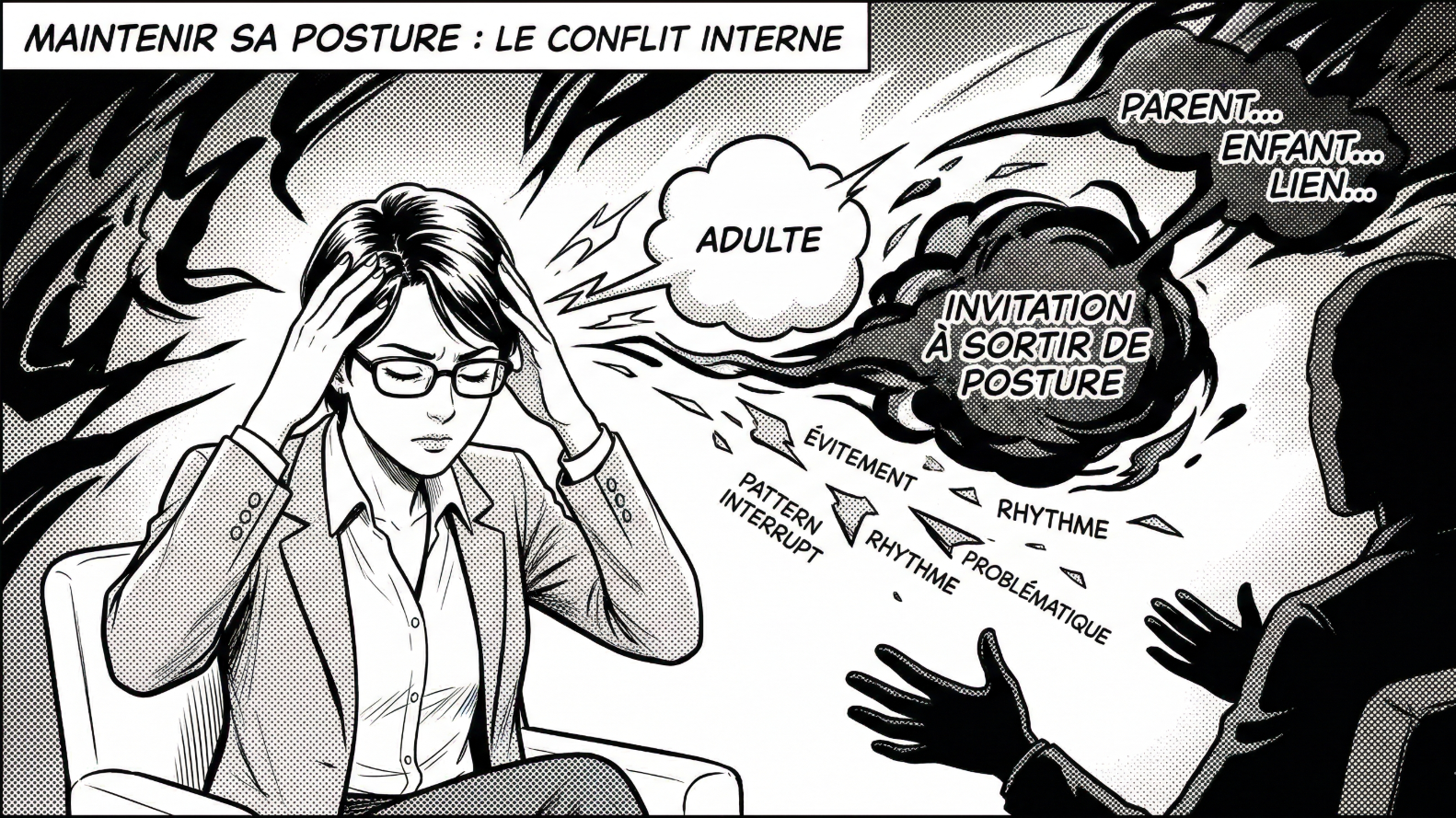
Dans l’accompagnement au quotidien, nous décidons, au travers des cadres que nous posons, de la posture que nous allons adopter. Cette posture est mûrement réfléchie, même si, dans un premier temps, nos pratiques relèvent un peu de l’improvisation. Une fois que l’on a décidé de prendre une posture, ne serait-ce que pour la tester sur quelques mois, il est important de pouvoir la maintenir pendant la session.
Il ne faut pas trop glisser vers une posture d’enfant si l’on a décidé d’être adulte, ou inversement, devenir trop parent si l’on a choisi une posture adulte. Cependant, l’interaction, le rapport et le lien avec le partenaire ou le consultant nous amènent souvent à faire vibrer et bouger des choses à l’intérieur de nous. Cet ensemble d’éléments peut créer une « invitation » à sortir de notre posture initiale.
Même si, sur le papier, se laisser emporter dans une posture d’invitation paraît peu important, stratégiquement, il en est autrement. L’invitation est très souvent une façon d’éviter la problématique qui était en train d’être analysée ou traitée. Surtout, cela peut imposer un temps de pause dans l’idée, l’objectif, ou la question proposée par le praticien. Cela provoque une interruption de pattern qui pourrait casser le rythme d’une session où quelque chose allait émerger ou être recadré.
Avoir la possibilité de ne pas répondre aux invitations, et surtout apprendre à poser ses limites face à ces invitations, les recadrer et les réorienter de la façon la plus juste, est aussi un travail à faire par nous et pour nous, en tant que praticien.
Prenez ce qui est bon et juste pour vous. Be One, Pank. https://www.pank.one/blog
—
Pank’s Reflections / Instant n°538 : Maintaining the Coaching Posture: The Art of Stability in the Face of Interactions
In daily coaching (or therapeutic) work, we decide, through the frameworks we set, on the posture we will adopt. This posture is carefully thought out, even if, initially, our practices involve a bit of improvisation. Once we have decided to adopt a specific posture, even just to test it out over a few months, it is essential to be able to maintain it during the session.
You shouldn’t slip too much into a « child » posture if you have decided to be an « adult, » or conversely, become too much of a « parent » if you have chosen an « adult » posture. However, the interaction, the rapport, and the bond with the client often cause things to vibrate and shift inside us. This combination of elements can create an « invitation » to step out of our initial posture.
Even if, theoretically, getting swept away in a posture of « invitation » seems minor, strategically, it is quite different. The invitation is very often a way to avoid the problematic issue currently being analyzed or treated. Above all, this can pause the idea, objective, or question proposed by the practitioner. This causes a « pattern interrupt » that could break the rhythm of a session where something was about to emerge or be reframed.
Having the ability not to respond to these invitations, and especially learning to set boundaries regarding these invitations, reframing and reorienting them in the most appropriate way, is also a work to be done by us and for us, as practitioners.
Take what is good and right for you. Be One, Pank. https://www.pank.one/blog
 Laboratoire Hypnose