Comme je vous en parlais avec le concept d’Hypnoseffort dans l’article précédent, au-delà de l’hypnose, nous nous retrouvons, tant dans notre modèle du monde que dans notre fonctionnement cérébral, à chercher les moyens qui nous épuiseront le moins.
Ce schéma du moindre effort est cohérent, mais jusqu’où nous entraîne-t-il avant de basculer dans une inaction pathologique (autrement dit, la fainéantise) ?
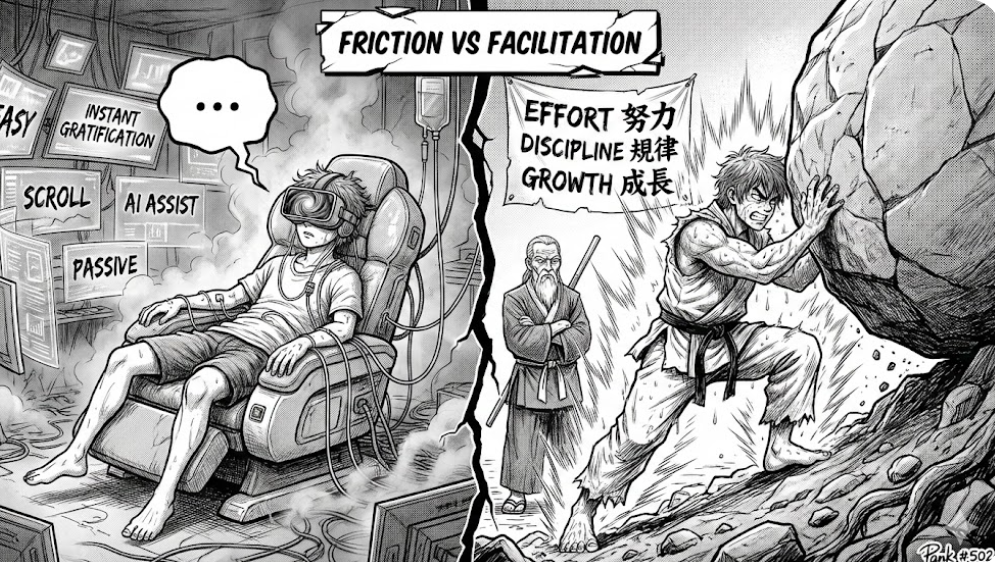
Hier à l’entraînement, un de mes gars a fait une réflexion juste quand je disais que le dojo est là pour préparer à la difficulté et à « résister » à des conditions problématiques. Il mettait en lumière le fait que notre société pousse vers l’inverse, notamment avec l’IA. Ce matin, j’entends un court reportage sur les dégâts des réseaux sociaux chez les jeunes, insistant surtout sur ce design tellement bien ficelé qu’il devient plus facile de continuer à scroller que de se mettre en action.
Il est vrai que notre intuition, qui vise à minimiser l’effort pour un résultat maximal, combinée à une technologie qui change nos vies, nous donne l’impression qu’il n’est plus nécessaire d’entrer en friction ou de faire des efforts pour obtenir quelque chose. Je n’aborderai même pas la notion matérialiste et consommatrice qui est la nôtre.
Pourtant, pour se développer au mieux, acquérir des compétences, voire atteindre des performances satisfaisantes, le cerveau et le reste du corps ont besoin d’effort, de discipline et de friction. Ils nécessitent cette lutte interne pour mémoriser, répéter ou conditionner notre être.
Nous sommes les seuls décisionnaires : allons-nous fournir un peu plus d’effort pour un gain de satisfaction différent de celui de l’obtention, parfois ultra-simplifiée, qui ôte toute valeur à de nombreuses acquisitions ?
Prenez ce qui est bon et juste pour vous. Be One, Pank. https://www.pank.one/blog
—
Pank’s Reflections / Snapshot #502: Friction vs. Facilitation
As I mentioned regarding « Hypnoseffort » in the previous article, beyond hypnosis, we find ourselves—both in our model of the world and in our cerebral functioning—seeking ways that will tire us the least.
This pattern of least effort is coherent, but how far does it lead us before we tip into pathological inaction (in other words, laziness)?
Yesterday at training, one of my guys made a valid point when I said the dojo exists to prepare us for difficulty and to « resist » problematic conditions. He highlighted that our society is pushing in the opposite direction, particularly with AI. This morning, I heard a short report on the damage caused by social networks among young people, insisting above all on this design so well crafted that it becomes easier to keep scrolling than to take action.
It is true that our intuition aimed at minimizing effort for maximum results, combined with technology that is changing our lives, gives us the impression that it is no longer necessary to enter into friction or expend effort to obtain something. I won’t even touch upon the materialistic and consumerist notion that we hold.
However, to develop optimally, acquire skills, or even reach satisfactory performance levels, the brain and the rest of the body need effort, discipline, and friction—that internal struggle to memorize, repeat, or condition our being.
We are the sole deciders: are we going to provide a little more effort for a gain in satisfaction different from that of often ultra-simplified acquisition, which strips value away from numerous achievements?
Take what is good and right for you. Be One, Pank. https://www.pank.one/blog
 Laboratoire Hypnose