
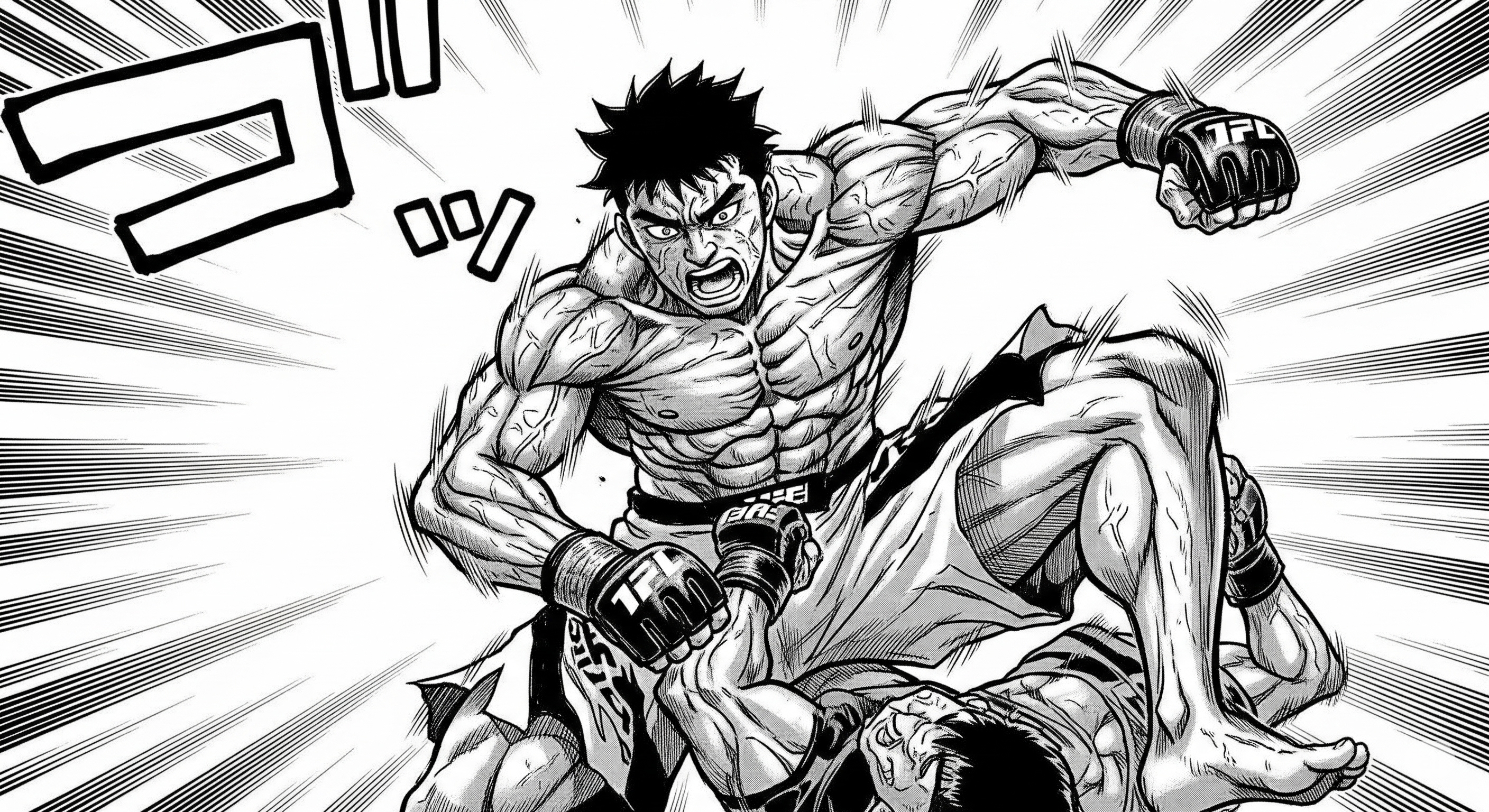
Le MMA, bien qu’issu du Vale Tudo et initialement influencé par le Jiu-Jitsu, est devenu tellement complet et autonome qu’aujourd’hui, les pratiquants de MMA sont de véritables « anti-Jiu-Jitsu ». On observe d’ailleurs que certains combattants de haut niveau, comme Pantoja ou même Topuria, pour ceux qui ont suivi l’UFC ce week-end, sont monstrueux au sol.
Ce qui est intéressant, c’est que le MMA est un système « anti-grappling » car il offre la possibilité de ne pas rester dans cette distance de combat. Contrairement à beaucoup d’arts martiaux, il y a une spécialisation sur la « fuite » ou l’évitement du sol. Pour amener le combat au sol, il faut d’abord gérer les frappes, puis réussir un takedown.
Ces dernières années, on a constaté qu’il n’y a pas de recours massif au « pull guard ». D’ailleurs, Drysdale, dans son livre, faisait remarquer qu’à l’époque des défis Gracie, jamais les adeptes du Jiu-Jitsu ne tiraient la garde ; ils avaient l’intention d’amener le combat au sol, d’où leurs cuisants échecs sur cette phase de combat face au Judo.
Aujourd’hui, ne serait-ce que pour entrer dans un monde de sol, c’est difficile, et comme je le partageais dans une autre réflexion, rien n’impose que le combat reste au sol. Par conséquent, si l’on n’est pas en position dominante, on ne peut pas maintenir cette distance de combat.
C’est peut-être pour cette raison que Carlson Gracie mettait tant en avant l’importance d’arriver en position supérieure ; pas seulement pour réussir à frapper en Vale Tudo, mais surtout pour garder la maîtrise du combat, car un combattant qui peut se relever assure l’impuissance du BJJ.
Il est intéressant de voir que les entraînements en MMA mettent plus l’accent sur les techniques permettant de se relever que sur la lutte au sol en tant que telle. Aller à la soumission, ce qui est initialement le point fort du Jiu-Jitsu, demande tellement de travail et de temps qu’il est souvent préférable de simplement empêcher la phase au sol de durer.
Le MMA est vraiment la discipline la mieux conçue pour poser problème au grappling, et c’est génial. Cela va imposer aux grapplers qui se lancent dans le MMA de développer de nouvelles réponses, ce qui est la qualité intrinsèque du Jiu-Jitsu : devenir souple pour s’adapter.
Prenez ce qui est bon et juste pour vous.
Be One,
Pank
—
English Translation: Martial Reflections of a Hypnofighter #398: MMA, the Anti-BJJ
MMA, although stemming from Vale Tudo and initially influenced by Jiu-Jitsu, has become so complete and self-sufficient that today, MMA practitioners are true « anti-Jiu-Jitsu » fighters. We can even see that some high-level competitors, like Pantoja or even Topuria, for those who watched the UFC this weekend, are monstrous on the ground.
What’s interesting is that MMA is an « anti-grappling » system because it offers the possibility of not staying in that combat distance. Unlike many martial arts, there’s a specialization in « escaping » or avoiding the ground. To take the fight to the ground, one must first manage strikes, then successfully execute a takedown.
In recent years, we’ve observed that there isn’t a widespread reliance on « pulling guard. » Furthermore, Drysdale, in his book, noted that during the Gracie challenge era, Jiu-Jitsu practitioners never pulled guard; their intention was to take the fight to the ground, hence their crushing failures in this phase of combat against Judo.
Today, just to enter the ground game is difficult, and as I shared in another reflection, nothing dictates that the fight must remain on the ground. Consequently, if you’re not in a dominant position, you cannot initially maintain that combat distance.
Perhaps this is why Carlson Gracie emphasized so much the importance of achieving a superior position; not only to successfully strike in Vale Tudo, but especially to maintain control of the fight, because a fighter who can stand up ensures the impotence of BJJ.
It’s interesting to see that MMA training places more emphasis on techniques for getting back to the feet than on ground wrestling as such. Going for a submission, which is initially the strong point of Jiu-Jitsu, requires so much work and time that it’s often preferable to simply prevent the ground phase from lasting.
MMA is truly the best-designed discipline to pose problems for grappling, and that’s great. This will force grapplers entering MMA to develop new responses, which is the intrinsic quality of Jiu-Jitsu: to become flexible to adapt.
Take what is good and right for you.
Be One,
Pank
 Laboratoire Hypnose