
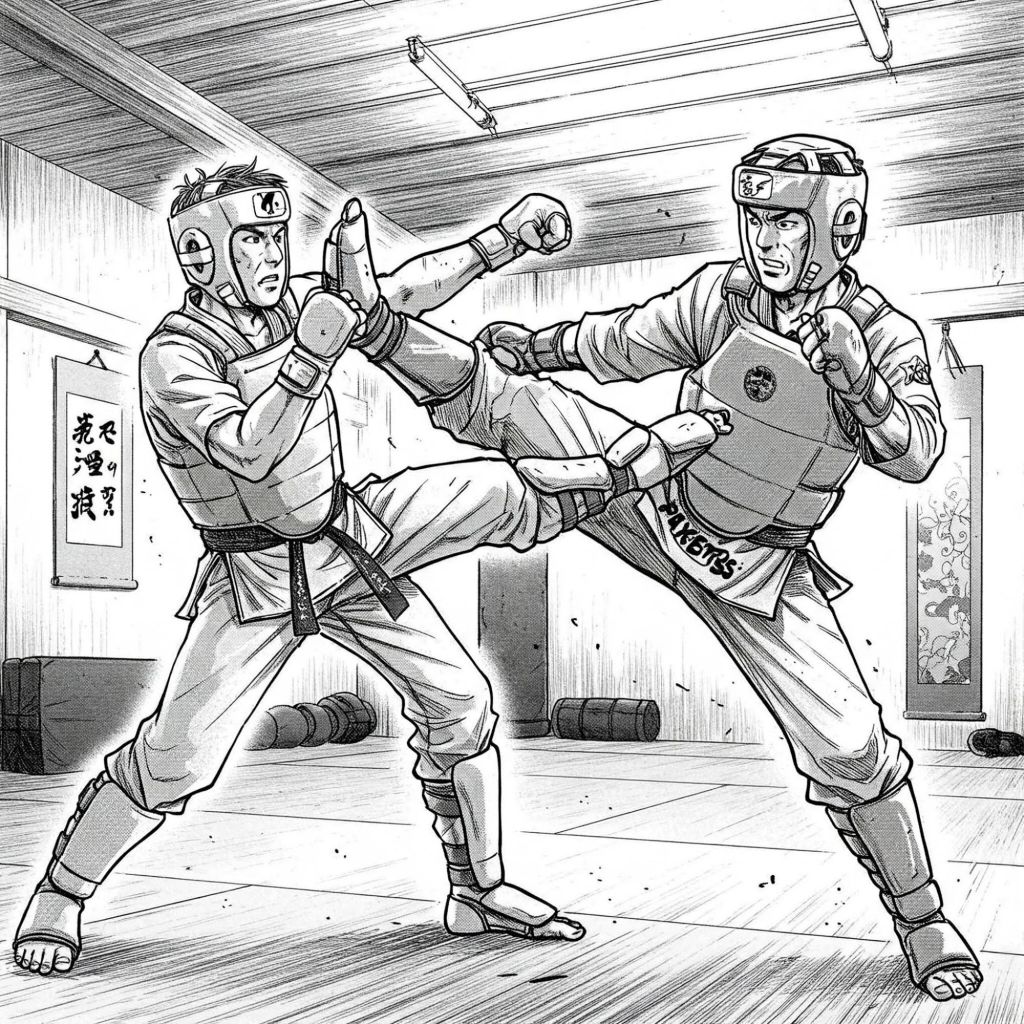
Lorsqu’on est dans un système de frappe, il arrive souvent que les combats d’entraînement commencent et peuvent assez rapidement devenir un véritable pugilat. Un des points essentiels dans l’entraînement est de démultiplier notre capacité à performer, tout en restant le plus apte possible à enchaîner d’autres combats.
S’il est sain d’avoir l’intention de bien impacter ses coups pour réussir à montrer que nos combinaisons et la puissance que nous dégageons sont justes, notre partenaire en face peut ne pas être prêt du tout à recevoir ce type d’action.
Ce qui crée réellement problème reste l’impact au niveau du visage. Si des styles comme le karaté Kyokushinkai ont l’habitude de ne pas travailler avec les frappes de poings au visage, la plupart des boxes ne se limitent pas à percuter au corps.
Il peut donc facilement y avoir des impacts qui vont, à court, moyen ou long terme, mettre notre partenaire dans un état qui va lui donner des conséquences potentiellement dangereuses pour l’avenir. Néanmoins, il reste important de pouvoir faire quelques combats où nous mettons de l’intensité ; c’est là où le rôle des protections est particulièrement important.
Réfléchir et mettre en place des entraînements où il y a une forte intensité tout en permettant d’avoir des conséquences aussi minimes que possible, surtout pour le cerveau, est une chose que les instructeurs doivent continuellement rappeler. Il n’y a rien de honteux à mettre beaucoup de protections, et encore moins à mettre des casques pour éviter que le cerveau ne soit touché.
Si réellement on veut frapper fort, il y a quand même beaucoup de parties du corps qui ne se blessent pas, notamment les cuisses, où il est possible de montrer l’impact de sa frappe.
Et vous, comment gérez-vous les combats durs que vous mettez en place dans votre salle ?
Prenez ce qui est bon et juste pour vous.
Be One,
Pank
http://www.passioncombat.net
—
Martial Reflections of an Hypnofighter #351: The Impact of Strikes During Training
When we are in a striking system, it often happens that training fights start and can quickly become a real boxing match. One of the essential points in training helps to multiply our ability to perform, while remaining as able as possible to chain other fights.
While it is healthy to have the intention to impact your blows well to succeed in showing that our combinations and the power we generate are correct, our partner in front may not be at all ready to receive this type of action.
What really creates a problem remains the impact on the face. If styles like Kyokushinkai karate are used to not working with punches to the face, most boxing styles are not limited to striking the body.
There can therefore easily be impacts that, in the short, medium or long term, put our partner in a state that will give them potentially dangerous consequences for the future. Nevertheless, it remains important to be able to do some fights where we put intensity; this is where the role of protections is particularly important.
Thinking and setting up training where there is high intensity while allowing for the least possible consequences, especially for the brain, is something that instructors must continually remind. There is nothing shameful in putting on a lot of protection, and even less in wearing helmets to prevent the brain from being affected.
If we really want to hit hard, there are still many parts of the body that do not get injured, especially the thighs, where it is possible to show the impact of your strike.
And you, how do you manage the hard fights that you set up in your gym?
Take what is good and right for you.
Be One,
Pank
http://www.passioncombat.net
 Laboratoire Hypnose